
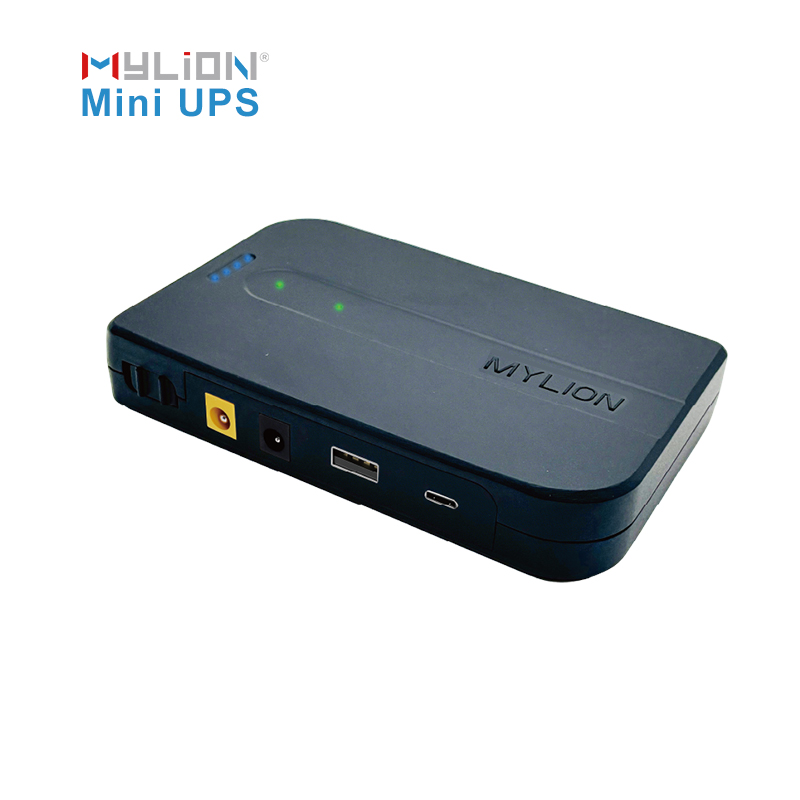
Network interruptions rarely announce themselves. A brief voltage dip or a momentary grid fault is often enough to force a router, ONT, or modem to reboot, breaking active connections and disrupting service continuity. For telecom operators, Internet Service Providers (ISPs), broadband network companies, and system integrators, selecting a Mini UPS that actually matches the device it protects is not a formality — it is the difference between a backup solution that works and one that fails silently in the field. Understanding how to estimate Mini UPS runtime using actual device wattage is therefore a core competency for any professional sourcing DC backup power at scale.
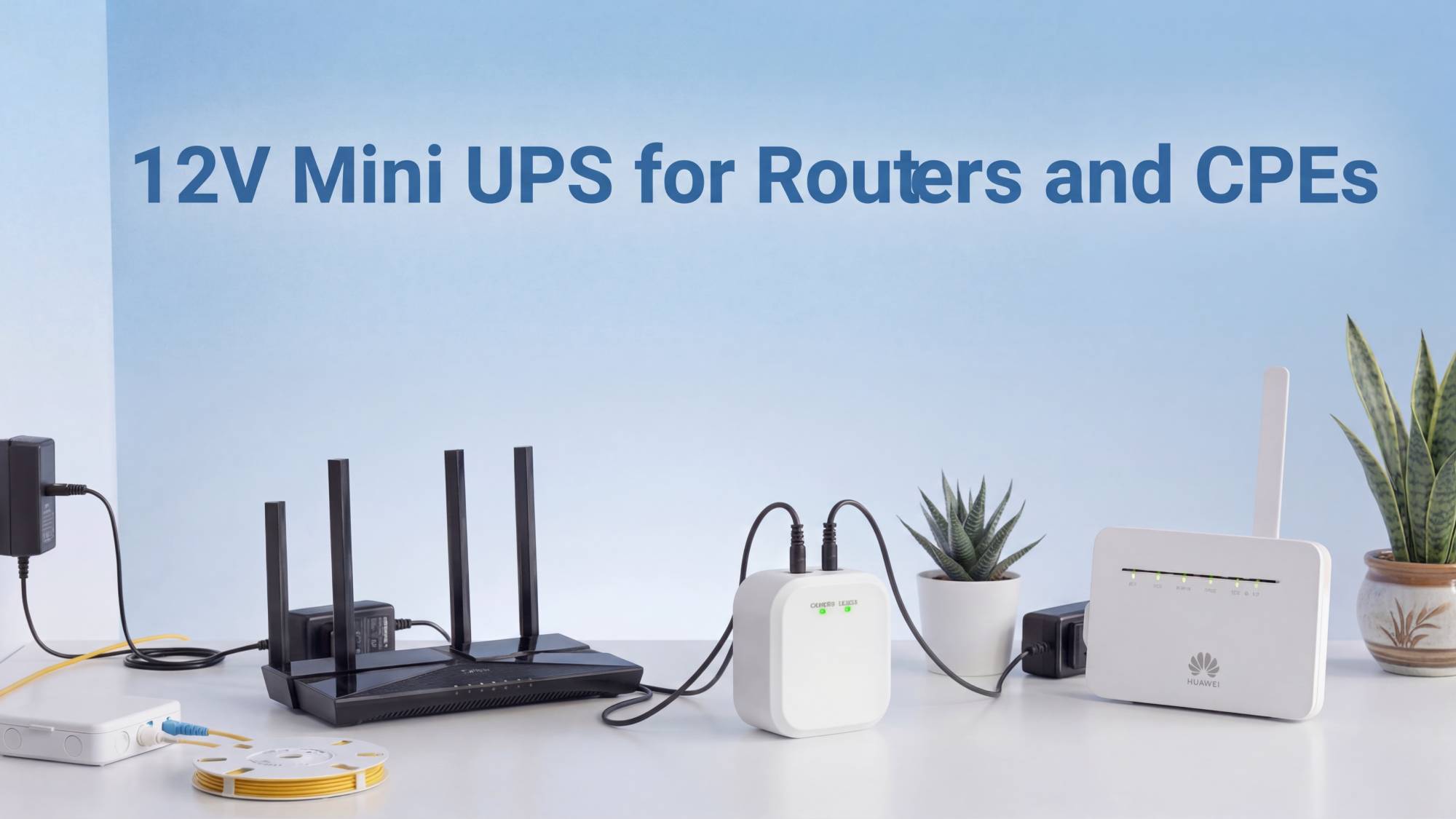
Why Actual Device Wattage Matters More Than Rated Labels
Many selection errors originate from relying on generic assumptions about voltage, current, or peak load rather than the real electrical behavior of the equipment being protected. A router’s nameplate rating does not always reflect its working current under load, and startup or peak current behavior can differ significantly from steady-state draw. This is precisely the industry pain point that Shanghai Mylion New Energy Co., Ltd., operating under the MYLION brand, has built its evaluation approach around: assessing solutions based on real device voltage, working current, peak or startup behavior, and installation environment, followed by technical confirmation and connector or cable matching to reduce avoidable selection risk.
The Core Method: Matching Battery Energy to Actual Load
The foundational relationship for estimating backup runtime is straightforward: the available battery energy, measured in watt-hours (Wh), divided by the actual power draw of the connected device, measured in watts (W), yields an estimate of runtime in hours. For example, if a device draws a steady 10W under real operating conditions, a battery rated at 30Wh would be expected to sustain that load for roughly three hours, before accounting for any conversion losses inherent in DC-DC or AC-DC power stages. This is why "actual device wattage" — not a generic or assumed figure — is the essential input for any credible runtime estimate. Overestimating available runtime by using idealized or rated figures, rather than measured working current, is one of the most common causes of backup power underperformance in ISP and broadband deployments.
Matching Battery Capacity Across the MYLION Product Lineup
Shanghai Mylion New Energy Co., Ltd. structures its Mini UPS portfolio around distinct battery energy tiers, allowing actual device wattage to be matched against an appropriate product rather than forcing a single generic solution onto every scenario.
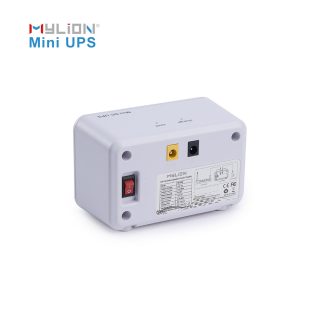
In the 12V Standard Series, the MU26W carries 18.72Wh of battery energy with a 12V DC output of 2.5A continuous and 3A maximum, suited to entry-level routers and ONTs. The MU48W steps up to 29.6Wh with the same 2.5A continuous output, while the MU68W reaches 44.4Wh with a maximum power output of 36W (12V/3A), positioned for professional ISP projects with somewhat higher energy needs.
For deployments where extended backup duration is the priority rather than higher current, the 12V Long-Runtime Series — the MU635W and MU635L — offers 75.6Wh of battery energy while maintaining the same 2.5A continuous/3A maximum output profile, addressing long-duration power outages in residential or remote installations.
Where the actual device wattage itself is higher — such as high-performance WiFi equipment or storage-integrated gateways drawing beyond standard thresholds — the 12V High-Power Series MU65W supports 4A continuous and 5A maximum output, totaling 60W, backed by 56.16Wh of battery energy. When both high current and long runtime are required simultaneously, the 12V High-Power Long-Runtime Series MU35W and MU35L combine the same 4A continuous/5A maximum output with an increased 75.6Wh battery capacity, intended for professional gateways requiring both high peak current and extended backup time.
For scenarios involving multiple simultaneous loads, the 12V + USB Multi-Output Series addresses combined 12V and USB device wattage. The MUJ46 provides 1.5A continuous/2A maximum 12V output alongside dual 5V/3A USB-A and USB-C ports, within an 18W total system limit and 37.44Wh battery energy, suited to small office/home office configurations. The MUJ435 extends this to 50.4Wh while retaining the same 18W system limit and port configuration.
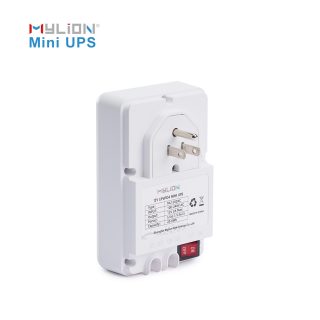
Installations combining two 12V devices from a single AC source are served by the AC-Input Dual Output Series ML1202AC, which uses LiFePO4 battery chemistry, accepts 100–240V AC input, and delivers two independent 12V DC outputs at 2A each within a 24W total system limit, backed by 25.6Wh of battery energy — commonly applied to combined ONT and router installations.
Emerging device categories are addressed through ongoing development directions. The MUC85, currently in project evaluation, targets USB-C Power Delivery devices such as WiFi 6/7 equipment, accepting 65W standard or 100W maximum PD input and delivering up to 65W and 30W across two USB-C outputs, supported by 92.16Wh of battery energy. The MU248 direction targets higher-voltage telecom equipment, using LiFePO4 chemistry with 48V/60V DC input and independent 24V (3A) and 48V (1A) outputs within a 100W system limit, backed by 102.4Wh of battery energy.
Beyond Wattage: Connectors, Voltage, and Peak Behavior
Estimating runtime from actual device wattage is necessary but not sufficient on its own. Voltage compatibility, connector type — such as the DC5521 input and DC5525 output configurations used across the 12V Standard Series — and startup or peak current behavior all influence whether a matched battery capacity will perform as estimated in the field. This is the basis for Mylion’s service approach: requirement analysis, model matching, sample testing support, connector and cable matching, private labeling, and documentation coordination, delivered through managed pilot evaluation ahead of mass-production preparation.
A Partner Built on Applied Backup Power Experience
With more than 13 years of experience in lithium battery technology and over 10 years specifically in Mini UPS development, Shanghai Mylion New Energy Co., Ltd. serves telecom operators, ISPs, broadband network companies, fiber network operators, and system integrators globally as a B2B backup power and OEM/ODM project partner. Its products carry model-specific UN38.3 and MSDS certifications supporting lithium battery transport and compliance documentation. For project teams working to estimate Mini UPS runtime from actual device wattage, this combination of energy-tiered product design and technical matching support offers a structured path from raw electrical requirements to a validated backup power deployment. Additional technical details are available at www.myliontech.com.
Reviews
There are no reviews yet.