
Cosmetic manufacturers rarely produce just one type of skincare product. A contract manufacturing facility may produce moisturizing creams in the morning, body lotions in the afternoon, and facial gels the following day. For smaller factories and emerging skincare brands, purchasing separate production equipment for every formulation is not always practical.
A multipurpose mixing system can offer greater production flexibility, but its suitability depends on more than vessel capacity or motor power. Creams, lotions, and gels develop their finished textures through different physical mechanisms. Some require intensive emulsification, while others depend on controlled polymer hydration or relatively gentle blending.
Understanding these differences helps manufacturers determine which products can share a production line and where specialized equipment or additional processing steps may be necessary.
Different Skincare Products Have Different Mixing Requirements
Although creams, lotions, and gels may contain similar ingredients, their internal structures can differ considerably. These differences influence the type of agitation, processing temperature, and mixing intensity required during manufacturing.
Creams commonly consist of oil and water phases stabilized by emulsifiers. Their relatively thick texture may also depend on waxes, fatty alcohols, and rheology modifiers. Manufacturing typically requires effective emulsification followed by controlled processing as the product develops its final consistency.
Lotions are generally more fluid than creams, although their viscosity varies by formulation. Their production requires sufficient dispersion and circulation to maintain uniformity without unnecessarily extending processing time.
Gels present a different challenge. Many water-based cosmetic gels rely on hydrated polymers to develop their internal structure. Some polymers require specific dispersion techniques, controlled hydration, or pH adjustment. Excessive mechanical processing can be unsuitable for certain shear-sensitive ingredients.
The following comparison illustrates why a single operating recipe cannot be applied to every skincare product.
| Product Type | Main Processing Requirement | Typical Manufacturing Concern |
|---|---|---|
| Facial cream | Emulsification and controlled texture development | Uneven consistency or emulsion instability |
| Body lotion | Liquid circulation and uniform emulsification | Inconsistent ingredient distribution |
| Moisturizing gel | Polymer dispersion and hydration | Lumps or irregular gel structure |
| Body butter | Effective mixing of concentrated oil and wax components | Poor circulation as the product thickens |
| Facial serum | Accurate ingredient incorporation and uniform blending | Damage to shear-sensitive ingredients |
| Cleansing balm | Controlled melting and blending of oil-based materials | Uneven crystallization or texture variation |
These are general processing considerations rather than fixed requirements. The actual manufacturing method should always be determined by the formulation and its intended quality characteristics.
What Makes a Cosmetic Mixer Suitable for Multiple Products?
A versatile cosmetic mixing system should provide several processing functions that can be adjusted independently. A machine designed around one fixed operating condition may struggle when a manufacturer introduces products with substantially different flow characteristics.
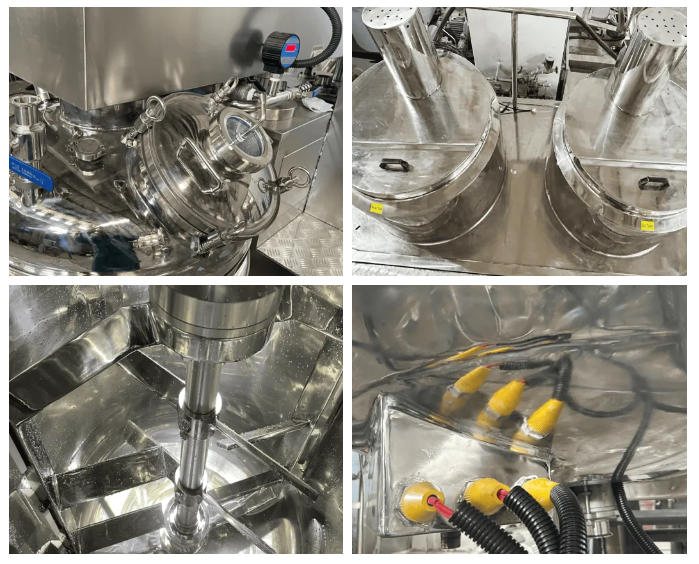
A vacuum emulsifying homogenizer mixer can be a practical option for factories producing emulsified skincare products because suitable configurations combine bulk agitation, high-shear homogenization, temperature control, and vacuum processing within a single system.
Each function serves a different purpose.
The main agitator maintains circulation throughout the vessel, helping distribute ingredients and transfer heat between the product and the vessel wall. The homogenizer provides more intensive localized mixing for emulsification and dispersion. Heating and cooling arrangements support formulations that require specific temperature profiles.
For multiproduct manufacturing, independent control of these functions is particularly valuable. A cream formulation may require homogenization during one production stage, while a gel manufactured in the same vessel may need considerably gentler treatment.
Equipment buyers should examine whether the homogenizer can be operated independently of the main agitator, whether mixing speeds are adjustable, and whether the vessel can accommodate different ingredient feeding sequences.
The goal is not to purchase equipment with the greatest possible mixing intensity. It is to select a system with a sufficiently broad operating range for the intended product portfolio.
Why Finished Product Viscosity Is Not Enough for Equipment Selection
Viscosity is frequently one of the first specifications discussed when purchasing cosmetic manufacturing equipment. However, the viscosity of a finished product does not necessarily describe how it behaves throughout production.
Two skincare products may have similar final viscosities while requiring very different manufacturing processes.
A thick moisturizing cream may begin as relatively fluid heated oil and water phases before developing its final structure during processing. A polymer-based gel may thicken rapidly after hydration or pH adjustment. An oil-based balm may become substantially more resistant to flow as its temperature decreases.
These changes affect equipment loading, circulation, ingredient incorporation, and discharge.
Manufacturers should therefore consider viscosity across the complete production cycle rather than relying exclusively on a single finished product measurement. Information about the material's flow behavior at different temperatures and processing stages can be more useful than its final viscosity alone.
Other characteristics also matter. Certain ingredients become difficult to disperse once the surrounding liquid has thickened. Some formulations require limited mechanical treatment after their internal structure has developed.
Providing equipment suppliers with a representative processing sequence allows them to evaluate agitation arrangements and motor requirements more accurately.
For factories producing several cosmetic formulations, the most demanding processing stage should be identified for each product before selecting a shared manufacturing system.
Product Changeovers and Cleaning in Shared Mixing Systems
Production flexibility is often evaluated according to how many products a machine can manufacture. An equally important consideration is how efficiently the equipment can be prepared for the next batch.
Changing from an unscented moisturizing cream to a heavily fragranced lotion may require additional cleaning to prevent fragrance carryover. Switching from a pigmented formulation to a clear facial gel can create visible contamination problems if previous product residues remain inside the equipment.
Residues may accumulate around agitator assemblies, vessel outlets, shaft connections, internal fittings, and transfer pipelines. Thick or oil-rich formulations can be particularly challenging to remove from poorly accessible areas.
When evaluating cosmetic processing equipment, manufacturers should examine the accessibility of product-contact surfaces, vessel drainage, discharge connections, and the availability of suitable cleaning arrangements.
A cleaning-in-place system may be useful for certain production environments, but its presence alone does not establish cleaning effectiveness. The actual cleaning procedure must suit the formulation, equipment design, cleaning agents, and required hygiene conditions.
Production scheduling can also reduce unnecessary changeover difficulties. Grouping formulations with similar ingredient bases, colors, or fragrance characteristics may simplify cleaning between batches. Such scheduling must still comply with established contamination-control procedures.
The time required for product discharge, cleaning, inspection, and preparation should be included when calculating manufacturing capacity. A machine with a larger vessel does not necessarily provide greater daily output if every product changeover creates substantial downtime.
When Separate Small-Batch Equipment Is Worth Considering
A large cosmetic production system may be suitable for established products with predictable demand, but using it for every development trial or limited production run can create operational inefficiencies.
Product development frequently involves adjustments to ingredient concentrations, emulsifier combinations, fragrance levels, or texture characteristics. Manufacturing large quantities before these variables have been evaluated increases material consumption and the amount of product that may require disposal.
A small vacuum emulsifying homogenizer may be more appropriate for formulation development, pilot production, and limited-volume skincare products, provided its design supports the required processing functions.
Separate small-batch equipment also allows development personnel to conduct trials without interrupting the main production schedule.
Different production requirements can be addressed through a combination of equipment sizes.
| Manufacturing Scenario | Suitable Equipment Approach |
|---|---|
| New formulation development | Small laboratory or pilot-scale mixing equipment |
| Limited-edition skincare products | Small-batch production system |
| Established products with regular demand | Production-scale emulsification equipment |
| Frequent formulation adjustments | Dedicated development or pilot mixer |
| Multiple high-volume product lines | Shared or dedicated production systems based on changeover requirements |
Small-scale equipment is not a guarantee that a formulation will behave identically in a larger vessel. Differences in geometry, circulation, heat transfer, and processing intensity still need to be evaluated before commercial production.
However, separating development activities from routine manufacturing can give cosmetic factories greater control over production schedules and formulation testing.
Equipment Planning for a Growing Cosmetic Product Portfolio
Before purchasing a multipurpose cosmetic mixing system, manufacturers should evaluate both their current products and the formulations they realistically expect to introduce.
A facility specializing in lightweight lotions may not initially require the same agitation capabilities as one producing concentrated creams, wax-rich balms, or thick gels. Future product development could change these requirements, but purchasing unnecessary equipment configurations without a defined manufacturing need can introduce additional maintenance and operational complexity.
A useful procurement process begins with documenting the intended product categories, minimum and maximum batch volumes, ingredient characteristics, processing temperatures, and expected cleaning requirements.
Factories should also identify which production activities can reasonably share equipment and which may benefit from dedicated systems. Products with incompatible cleaning requirements, highly specialized processing conditions, or frequent simultaneous production demands may be better handled separately.
Equipment trials using representative formulations can provide valuable information that cannot be obtained from technical specifications alone. Buyers can evaluate mixing uniformity, discharge behavior, temperature control, cleaning accessibility, and the ability to operate under different processing conditions.
One cosmetic mixing machine can manufacture several types of skincare products when its configuration matches their actual production requirements. The most effective equipment strategy is not necessarily to consolidate every product into one vessel, but to establish a manufacturing arrangement that balances formulation flexibility, product quality, cleaning requirements, and daily production capacity.

Reviews
There are no reviews yet.