
Product Introduction
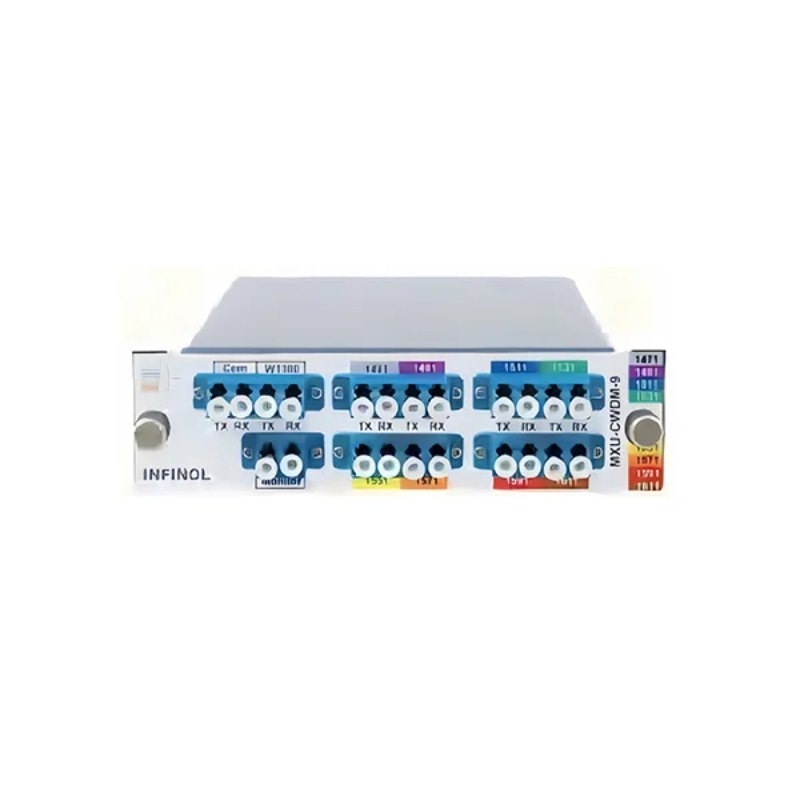
The CWDM Mux/Demux is a coarse wavelength division multiplexing solution designed to combine multiple optical wavelengths onto a single-mode fiber for transmission and separate them at the receiving end. By utilizing the low-loss transmission window of single-mode fiber, CWDM technology helps increase network capacity while reducing the need for additional fiber resources.
The CWDM Mux/Demux supports wavelength channels from 1270 nm to 1611 nm with 20 nm channel spacing and a channel passband of CWL ±6.5 nm. The solution can support network configurations using single-fiber unidirectional, single-fiber bidirectional, and dual-fiber bidirectional transmission.
With low insertion loss, wide bandwidth, high channel isolation, and stable optical performance, the equipment is suitable for access networks, metropolitan area network applications, data centers, telecommunications infrastructure, campus networks, and other optical communication environments.
Manufactured and supplied by Infinol Technology (shenzhen) Co., Ltd., the product is available in multiple package formats and can be customized according to customer wavelength plans and network requirements.
Key Product Features
1. Multi-Wavelength Transmission over Single Fiber
CWDM technology allows multiple optical wavelengths to be combined and transmitted through a single-mode optical fiber. This can help optimize existing fiber resources and expand network transmission capacity without requiring an equivalent increase in physical fiber infrastructure.
2. Wide Wavelength Range
The specified wavelength range covers 1270 nm to 1611 nm. With 20 nm channel spacing, the solution supports multiple CWDM wavelength channels for different network configurations.
The system can support smooth network expansion according to the required wavelength plan, with configurations supporting up to 18 wavelength channels.
3. Mux, Demux and OADM Configurations
The product can be configured for different wavelength management functions, including:
-
CWDM Mux
-
CWDM Demux
-
OADM
-
Combined Mux/Demux configurations
These options provide flexibility for different optical network architectures.
4. Low Insertion Loss
Low insertion loss helps reduce optical power loss during wavelength multiplexing and demultiplexing. This supports efficient optical transmission within compatible link budgets.
5. High Channel Isolation
High channel isolation helps reduce interference between different wavelength channels, supporting stable multi-channel optical transmission.
6. Wide Bandwidth
The CWDM solution provides a wide optical passband around each central wavelength, supporting compatible optical communication equipment across different transmission rates.
7. High Stability and Reliability
The optical components are designed for stable operation in optical communication networks. The product is stated to comply with Telcordia GR-1221 requirements, with product configurations also available to meet GR-1209 and GR-1221-CORE requirements.
8. Flexible Packaging
The CWDM Mux/Demux is available in several package formats, including:
-
Mini-cassette
-
Fiber tray
-
LGX
-
ABS box
-
19-inch 1U rackmount
The package can be selected according to installation space and network architecture.
9. Flexible Wavelength Combination
Different ITU wavelength plans can be combined according to customer requirements. This allows the CWDM system to be configured for different transmission networks and upgrade plans.
10. Customized Configuration
The product can be fully customized according to customer requirements, including wavelength combinations, package formats, fiber configurations, and network application conditions.
Technical Specifications
| Item | Specification |
|---|---|
| Product | CWDM Mux/Demux |
| Part Number | CWMSSXX |
| Central Wavelength | 1270–1611 nm |
| Channel Spacing | 20 nm |
| Channel Passband Width | CWL ±6.5 nm |
| Available Functions | MUX / DMUX / OADM |
| Package Options | ABS Box / LGX / 19-inch 1U Rack |
| Operating Temperature | -10°C to 75°C |
| Wavelength Configuration | Customer-selected ITU wavelength plan |
| Supported Transmission Rates | 1.25G / 2.5G / 10G configurations |
| Wavelength Range for Listed Item | 1271–1611 nm |
| Application | Optical fiber communication and network transmission |
Actual optical specifications such as insertion loss, return loss, isolation, and channel configuration should be confirmed according to the selected wavelength combination and product configuration.
Wavelength Configuration
CWDM uses separated optical wavelengths to transmit multiple channels over the same fiber. The specified system covers the 1270–1611 nm wavelength range with 20 nm spacing.
The product supports flexible wavelength planning and can be configured according to the customer's network requirements. This allows users to select appropriate CWDM channels rather than deploying every available wavelength.
Configurations can support network upgrades involving multiple wavelength channels, with the overall CWDM architecture supporting up to 18 wavelength channels according to the supplied product information.
Mux and Demux Functions
CWDM Mux
The multiplexer combines multiple optical wavelengths from different transmission channels into a single fiber for transmission.
This configuration is useful when multiple optical signals need to share the same fiber infrastructure.
CWDM Demux
The demultiplexer separates the combined optical wavelengths at the receiving side and routes individual wavelengths to their corresponding optical channels.
CWDM Mux/Demux
A combined Mux/Demux configuration can be used for bidirectional wavelength management, depending on the network topology and fiber architecture.
OADM
Optical Add-Drop Multiplexer configurations can be used to add or drop selected wavelength channels within an optical network.
Supported Network Configurations
The CWDM solution supports multiple optical transmission architectures, including:
-
Single-fiber unidirectional transmission
-
Single-fiber bidirectional transmission
-
Dual-fiber bidirectional transmission
The appropriate configuration should be selected according to the number of fibers available, transmission direction, wavelength plan, and network topology.
Optical Performance
The CWDM Mux/Demux is designed around several key optical performance characteristics:
Low Insertion Loss: Helps maintain the available optical power budget across the multiplexing and demultiplexing path.
High Isolation: Helps minimize unwanted optical interaction between adjacent wavelength channels.
Wide Passband: The specified channel passband is CWL ±6.5 nm, providing the optical operating window around each central wavelength.
Stable Operation: Designed for reliable operation within the specified temperature range of -10°C to 75°C.
Actual optical performance depends on the selected channel count, wavelength combination, fiber type, package, and specific product configuration.
Transmission Rate Options
The listed CWDM product can be configured for 1.25G, 2.5G, and 10G optical transmission applications within compatible system configurations.
CWDM technology is suitable for networks where multiple optical signals need to be transported over shared fiber infrastructure. The appropriate optical transceiver and wavelength should be matched to the selected CWDM channel.
Packaging Options
Different deployment environments require different mechanical formats. The CWDM Mux/Demux can be supplied in multiple package types:
ABS Box
A compact enclosed format suitable for installations where a standalone optical component package is required.
Mini-Cassette
Suitable for compact fiber management and equipment integration.
Fiber Tray
Designed for organized fiber installation and optical component management.
LGX
Suitable for modular rack-based optical network deployment.
19-Inch 1U Rackmount
Suitable for centralized optical network equipment rooms and rack-based installations.
The final package should be selected according to the customer's cabinet, rack, fiber management, and installation requirements.
Applications
The CWDM Mux/Demux can be used in a variety of optical communication and data transmission environments, including:
-
Metropolitan area networks
-
Access networks
-
Campus networks
-
Data centers
-
Cloud storage networks
-
Telecommunications networks
-
Transmission networks
-
Trunk cable networks
-
Radio and television stations
-
Base stations
-
Fiber optic access systems
-
Data communication infrastructure
It is particularly suitable for applications where existing fiber resources need to support additional wavelength channels.
Advantages for Fiber Resource Optimization
Deploying additional fiber can increase infrastructure requirements in networks where fiber resources are limited. CWDM provides an alternative by allowing multiple wavelengths to share the same single-mode fiber.
A properly configured CWDM system can therefore help network operators make better use of existing fiber infrastructure while providing additional optical channels for network expansion.
The actual benefit depends on the available fiber, optical budget, required channel count, transmission distance, and network architecture.
OEM and ODM Services
Infinol Technology (shenzhen) Co., Ltd. provides OEM and ODM services for active and passive optical communication products.
For CWDM projects, customized solutions can be developed according to requirements such as:
-
Central wavelength
-
Number of CWDM channels
-
Mux/Demux configuration
-
OADM requirements
-
Fiber type
-
Connector type
-
Package format
-
Rack installation
-
Transmission rate
-
Network topology
-
Operating environment
Customers can provide network diagrams or technical specifications for configuration evaluation.
Company Profile
Infinol Technology (shenzhen) Co., Ltd. specializes in the R&D, production, and sales of optical communication products. The company provides optical fiber products and solutions for data communication, optical storage, and telecommunications applications.
Its product portfolio covers a broad range of optical transceiver and connectivity products, including CSFP, SFP, BIDI, SFP+, CWDM, DWDM, XFP, SFP28, QSFP+, CFP, CFP2, CFP4, SFP56, QSFP28, QSFP56, QSFP-DD, OSFP, SFP112, and QSFP112.
The company also supplies high-speed DAC and AOC cables for storage, data, and high-performance computing interconnections, as well as MPO and MTP high-density trunk cables for data center applications.
Optical Communication Product Range
The company's product range supports optical communication applications across multiple transmission speeds, including:
-
155M
-
1.25G
-
2.5G
-
10G
-
25G
-
100G
-
200G
-
400G
-
800G
Product selection depends on the required network protocol, transmission distance, optical wavelength, fiber type, and equipment interface.
Standards and Compatibility
The company's optical products are designed for applications involving common optical communication standards and technologies, including:
-
Ethernet
-
Fiber Channel
-
InfiniBand
-
SONET
-
SDH
-
OTN
-
CPRI
-
PON
Specific product compatibility should be confirmed according to the target equipment and network application.
B2B Ordering and Product Selection
Before purchasing a CWDM Mux/Demux, buyers should confirm:
-
Required CWDM wavelength channels
-
Central wavelength plan
-
Number of channels
-
Mux, Demux, or combined configuration
-
Single-fiber or dual-fiber architecture
-
Unidirectional or bidirectional transmission
-
Required transmission rate
-
Fiber type
-
Connector requirements
-
Package format
-
Installation method
-
Operating temperature
-
Required optical performance
-
Existing optical transceiver compatibility
Providing a network diagram or detailed optical link requirements can help determine a suitable CWDM configuration.
FAQ
What is a CWDM Mux/Demux?
A CWDM Mux/Demux is an optical wavelength division multiplexing component that combines multiple wavelengths onto one fiber and separates them at the receiving end.
What wavelength range does this product support?
The specified central wavelength range is 1270–1611 nm with 20 nm channel spacing.
How many wavelength channels can CWDM support?
The supplied product information states that the CWDM solution can support up to 18 wavelength channels according to the wavelength configuration.
Can the product be used for bidirectional transmission?
Yes. The solution supports single-fiber unidirectional, single-fiber bidirectional, and dual-fiber bidirectional configurations.
What package options are available?
Available formats include ABS box, mini-cassette, fiber tray, LGX, and 19-inch 1U rackmount configurations.
Does the product support OADM?
Yes. OADM is one of the available configuration options.
What transmission rates are supported?
The listed CWDM configurations include 1.25G, 2.5G, and 10G applications. The suitable configuration should be matched with the optical transceiver and network equipment.
Can the wavelength combination be customized?
Yes. The product supports customized wavelength combinations based on the customer's ITU wavelength plan and network requirements.
Is OEM/ODM service available?
Yes. OEM and ODM services are available for active and passive optical communication products.
Product Summary
The CWDM Mux/Demux provides multi-wavelength fiber transmission with 20 nm channel spacing, low insertion loss, high isolation, flexible packaging, and customizable wavelength configurations for scalable optical networks.

Reviews
There are no reviews yet.