
Why Turbo Fans Are Becoming Popular for Portable Applications
Portable air devices are evolving beyond traditional fans and cleaning tools. Consumers and professional users increasingly expect one compact appliance to handle multiple tasks, including dust removal, surface drying, cooling, inflation, and outdoor applications. A turbo fan meets these requirements by generating concentrated high-speed airflow through an optimized motor and air channel design.
Unlike conventional handheld fans, high-speed turbo fans focus on airflow intensity rather than simply circulating ambient air. This makes them useful for cleaning electronic equipment, removing debris from vehicle interiors, drying surfaces, and supporting various outdoor activities. For brands and distributors, multifunctional airflow devices also create opportunities to develop differentiated consumer electronics products.
How a High-Speed Brushless Motor Improves Airflow Performance
Motor performance is one of the most important factors when evaluating a high-speed turbo fan. A brushless DC motor can operate at high rotational speeds while reducing mechanical friction associated with traditional brushed structures. This design supports efficient airflow generation, improved durability, and reliable operation.
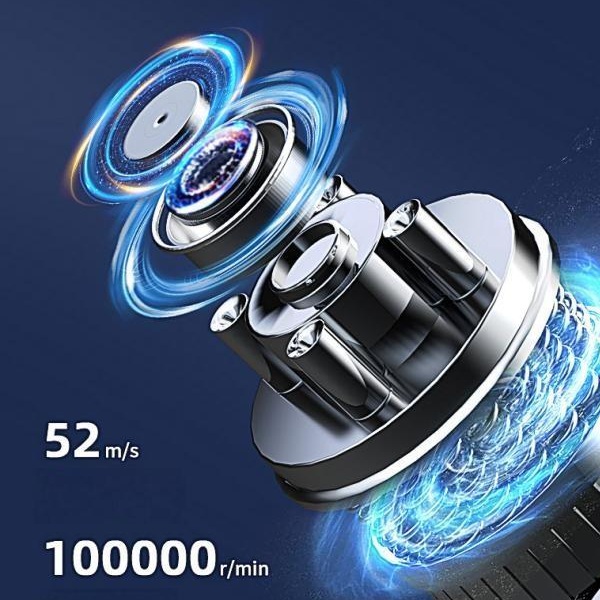
Century TianDing's turbo fan features a brushless motor reaching up to 100,000 RPM, with airflow speeds of up to 52 m/s. These characteristics allow the device to generate concentrated airflow for demanding cleaning and blowing applications.
However, maximum motor speed should not be the only purchasing consideration. Air channel design, electronic control, heat management, and overall structural efficiency also influence actual performance. A well-engineered portable blower needs to coordinate these elements to maintain effective airflow while keeping its dimensions and energy consumption under control.
Three Adjustable Speeds for Different Airflow Requirements
Different cleaning and blowing tasks require different airflow intensities. Using maximum power for every application may consume unnecessary battery energy, while insufficient airflow can reduce working efficiency. Adjustable speed control provides a more practical solution.
The turbo fan offers three operating levels to accommodate different requirements:
| Operating Mode | Motor Speed | Typical Applications |
|---|---|---|
| Standard Mode | 30,000 RPM | Daily dust removal and electronics cleaning |
| Strong Wind Mode | 60,000 RPM | Vehicle interiors and workspace cleaning |
| Hurricane Mode | 100,000 RPM | Rapid drying and demanding blowing tasks |
This multi-speed configuration allows users to select an appropriate airflow level according to the task. For delicate electronic equipment, controlled airflow may be preferable, while outdoor cleaning and drying applications can benefit from stronger output.
Lightweight Construction and Cordless Operation
Portability is another important consideration when choosing a mini turbo fan. Heavy equipment can be inconvenient for users who need to move between work areas or carry cleaning tools during travel. A lightweight handheld design makes it easier to operate the device in different environments.
Weighing approximately 220 grams, the Century TianDing turbo fan is designed for convenient handling and transportation. Its compact construction supports applications at home, in vehicles, at workplaces, and during outdoor activities.
The rechargeable 2000mAh battery provides up to 4.5 hours of operation in soft mode. Actual operating time varies according to the selected speed and usage conditions. For users who prioritize mobility, cordless operation removes the restrictions associated with power cables and provides greater flexibility.
Multifunctional Applications Beyond Conventional Dust Cleaning
A portable turbo fan blower can serve a wider range of purposes than a conventional dust blower. Its concentrated airflow makes it suitable for removing dust and debris from keyboards, computer components, electronic equipment, and vehicle interiors.
Its applications can also extend into other areas:
-
Electronics cleaning: Removes loose dust and debris from equipment surfaces and hard-to-reach areas.
-
Automotive maintenance: Helps clean vehicle interiors and remove debris from narrow spaces.
-
Rapid drying: Provides concentrated airflow for drying wet surfaces and other suitable applications.
-
Outdoor activities: Supports charcoal ignition assistance and other outdoor blowing tasks.
-
Inflation: Can support compatible air cushion inflation applications.
-
Snow removal: Helps clear loose snow from vehicle glass and exterior surfaces.
When using high-speed airflow around sensitive electronic components, users should follow appropriate cleaning procedures and maintain a suitable distance to avoid damaging delicate parts.
What Buyers Should Consider When Sourcing a Turbo Fan
For importers, wholesalers, and private-label brands, selecting a turbo fan manufacturer involves evaluating more than maximum airflow and motor speed. Battery performance, electronic control, housing construction, product safety, and manufacturing consistency all influence the final product's commercial value.
Buyers should pay particular attention to motor durability, speed adjustment accuracy, charging performance, and operating stability. They should also review whether the manufacturer can provide suitable product testing, packaging customization, and technical documentation for the intended market.
Electrical specifications and battery-related compliance requirements should be confirmed before mass production. Clear communication during the sourcing stage helps avoid unnecessary changes and supports a more efficient product development process.
OEM and ODM Turbo Fan Manufacturing Solutions
For businesses planning to launch their own portable airflow products, an experienced OEM turbo fan manufacturer can provide support beyond finished-product assembly. Product development may involve industrial design, structural optimization, hardware circuit development, PCBA engineering, software integration, mold development, and prototype testing.
Shenzhen Century TianDing Technology Co., Ltd. provides integrated OEM and ODM manufacturing services for international customers. Its capabilities cover product design, PCBA assembly, SMT manufacturing, DIP processing, component sourcing, finished-product assembly, and quality inspection.
The company operates a 2,500-square-meter manufacturing facility in Shenzhen and provides customized solutions for different electronic product requirements. Its production resources include four SMT lines, a DIP wave soldering line, and a product assembly line, supported by automated inspection and processing equipment.
With a stated production capacity of up to 80 million units per month, Century TianDing supports both prototype development and large-scale manufacturing projects. Buyers can discuss customized motor configurations, battery solutions, charging arrangements, electronic control modules, product appearance, and packaging according to project requirements.
Building a Competitive Portable Airflow Product
The commercial potential of a turbo fan comes from its combination of concentrated airflow, compact construction, and multiple applications. Rather than positioning it as a single-purpose cleaning device, brands can develop product offerings around electronics maintenance, automotive accessories, household cleaning, and outdoor equipment.
For businesses entering this product category, choosing the right manufacturing partner is equally important. A supplier with engineering, electronics assembly, and production capabilities can help coordinate product development from initial concept to finished goods.
Century TianDing combines OEM/ODM development resources with electronics manufacturing capabilities to support customers seeking customized turbo fans and other portable electronic products. Evaluating product performance alongside manufacturing strength provides a more reliable foundation for long-term sourcing cooperation.
Frequently Asked Questions
1. What is a turbo fan used for?
A turbo fan generates concentrated high-speed airflow for dust removal, drying, cooling, inflation, and various cleaning applications.
2. What are the advantages of a brushless motor?
Brushless motors support high rotational speeds, efficient airflow generation, and reduced mechanical wear, making them suitable for compact high-performance blowers.
3. How powerful is the Century TianDing turbo fan?
It reaches up to 100,000 RPM and provides airflow speeds of up to 52 m/s, with three adjustable operating modes.
4. How long can the rechargeable turbo fan operate?
Its 2000mAh battery supports up to 4.5 hours of continuous operation in soft mode. Actual runtime depends on the selected speed.
5. Can turbo fans be customized for private-label brands?
Yes. OEM and ODM services can include product appearance, motor configurations, battery solutions, electronic control modules, branding, and packaging.
6. What should buyers look for in a turbo fan supplier?
Important factors include motor performance, product engineering, battery reliability, quality inspection, customization capabilities, production capacity, and international market support.







Reviews
There are no reviews yet.