
Standing, walking, turning the head, or responding to an unexpected movement all require the nervous system to continuously process information from vision, the vestibular system, and somatosensory input. When these systems cannot work together effectively, patients may experience dizziness, instability, postural control problems, or an increased risk of falling.
For clinicians, the challenge is not simply determining whether a patient can stand. The more important question is how the patient maintains balance when sensory information changes or when the body is exposed to controlled movement.
This is one of the reasons Computerized Dynamic Posturography (CDP) has become an important approach to balance assessment. CDP can evaluate how patients respond to controlled sensory and postural challenges, offering clinicians information about sensory integration and postural control strategies that may not be obvious during a conventional examination.
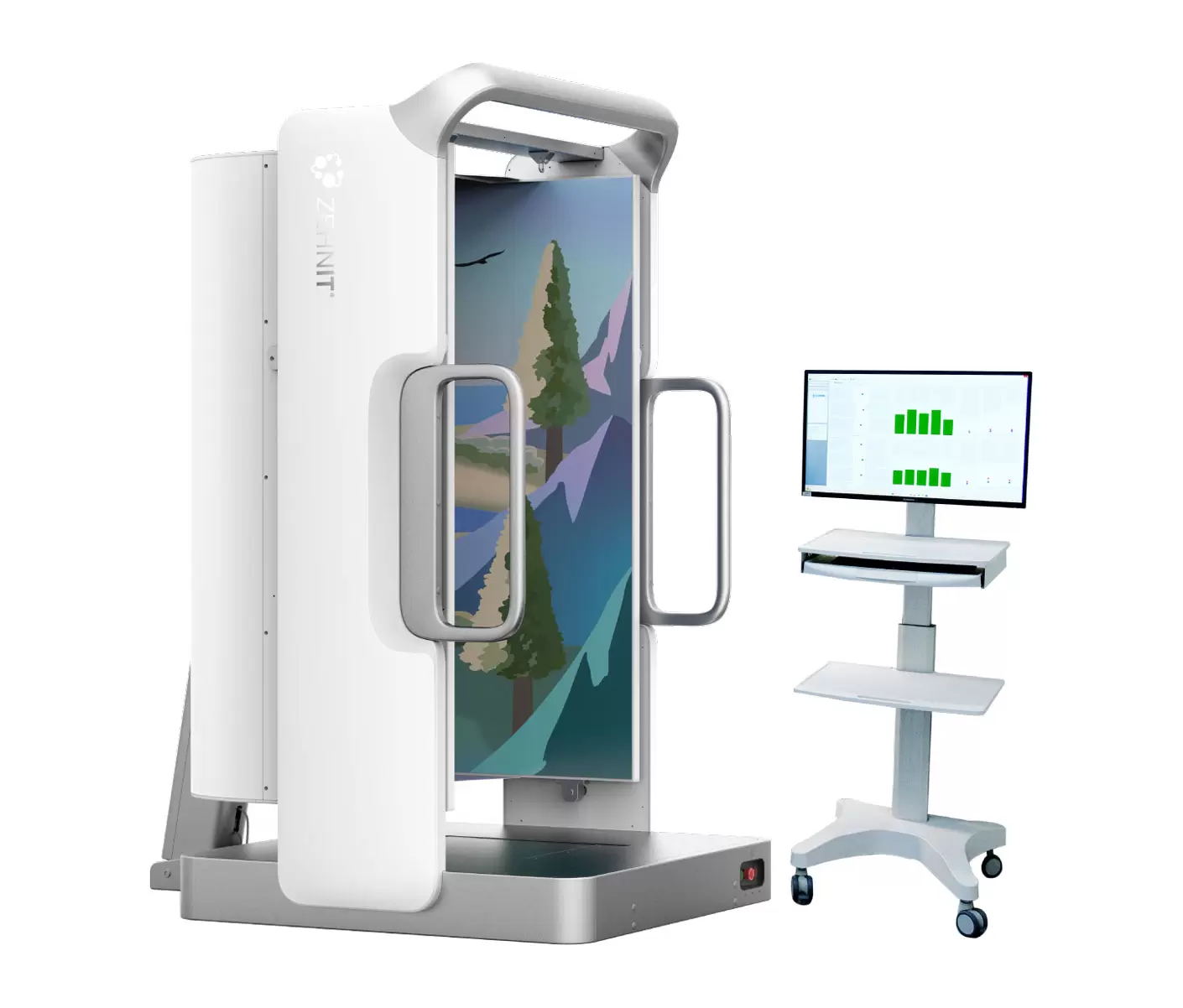
With this clinical need in mind, ZEHNIT developed VertiPlatform™-Dynamic, an advanced platform for dynamic balance assessment and rehabilitation that combines a high-precision motion platform, high-frame-rate force sensing, configurable visual stimulation, and an innovative dual-vision approach.
Dual-Vision Technology Creates More Testing Possibilities
One of the most distinctive aspects of VertiPlatform™-Dynamic is its dual-vision stimulation system.
Instead of relying on one visual environment for every patient, the platform provides two configurable options: Physical Mode and VR Mode.
Physical Mode uses the surrounding walls together with an integrated feedback screen. This creates a familiar physical environment while still providing visual feedback during assessment and rehabilitation.
VR Mode, in contrast, places the patient in an immersive and interactive virtual environment. This can introduce a more engaging visual experience, particularly during rehabilitation activities.
The ability to switch between these two modes gives clinicians greater flexibility. Different patients have different tolerances to immersive environments, and different testing or training objectives may call for different visual conditions.
Rather than applying one visual approach to every situation, VertiPlatform™-Dynamic allows clinicians to select the environment that best fits the patient and the purpose of the session.
Balancing Immersion with Patient Comfort
Immersive technology has opened new possibilities in rehabilitation, but not every patient responds to it in the same way.
Some patients may find a virtual environment engaging and motivating, while others may be uncomfortable with immersive visual stimulation. This consideration is particularly relevant for patients who already experience dizziness or motion sensitivity.
VertiPlatform™-Dynamic addresses this issue by offering both physical and VR-based visual environments.
When immersive interaction is appropriate, VR Mode can provide a dynamic setting for assessment and training. When a more familiar visual environment is preferable, Physical Mode offers an alternative without requiring full VR immersion.
This flexibility is an important part of patient-centered balance assessment because it allows clinicians to adapt the experience instead of forcing every patient into the same testing condition.
Precision Motion and Real-Time COG Detection
Accurate balance assessment depends on reliable measurement.
VertiPlatform™-Dynamic integrates a high-precision motion platform with high-frame-rate force sensors to monitor the patient's center of gravity (COG) response in real time.
The platform movement and visual input are coordinated to create controlled sensory challenges, while the sensing system captures the resulting postural responses.
This synchronized approach is important because balance assessment is fundamentally about relationships—between the body's movement, the support surface, visual information, and the patient's ability to regain stability.
By recording these responses with high temporal resolution, the platform provides clinicians with objective data for understanding postural control and sensory integration.
A More Natural Interaction Between Movement and Feedback
A clinical balance system should not feel disconnected from the patient's movement.
If there is a noticeable delay between physical movement and visual feedback, the interaction may feel unnatural and could affect the patient's response. VertiPlatform™-Dynamic is designed to provide a fluid, low-latency interaction between motion and visual feedback.
This creates a more natural testing and rehabilitation experience.
For clinicians, smoother interaction helps maintain consistent testing conditions. For patients, it can reduce unnecessary anxiety and make it easier to focus on the task.
The difference may seem small, but during balance training, the relationship between movement and feedback can directly influence how patients interact with the system.
More Than Dynamic Testing
Although the name emphasizes dynamic posturography, VertiPlatform™-Dynamic is designed to support more than dynamic assessment alone.
Its software includes a combination of dynamic assessment, static assessment, and rehabilitation modules, allowing clinicians to use one platform for different stages of patient management.
Dynamic assessment includes:
-
Sensory Organization Test (SOT)
-
Motor Control Test (MCT)
-
Adaptation Test (ADT)
Static assessment includes:
-
Romberg
-
Modified Clinical Test of Sensory Interaction on Balance (mCTSIB)
-
Limits of Stability (LOS)
-
Rhythmic Weight Shift (RWS)
-
Fall Risk
-
Balance Error Scoring System (BESS)
The platform also provides rehabilitation activities including Stance, Pong, Hit, Collect, and Drive, with additional modules available.
This combination allows clinicians to move from assessment to training without necessarily switching to an entirely different system.
Turning Clinical Data into Rehabilitation Strategies
A balance assessment is most valuable when it helps guide what comes next.
When clinicians understand how a patient responds to sensory challenges, they can use that information to develop more targeted rehabilitation strategies.
VertiPlatform™-Dynamic brings assessment and rehabilitation together within the same platform. After evaluating balance performance, clinicians can use interactive training modules to challenge the patient's postural control in a controlled environment.
This creates a more continuous workflow:
Assessment identifies functional characteristics.
Training provides targeted challenges.
Repeated sessions help clinicians observe changes over time.
This integrated model can make rehabilitation more structured while helping patients experience a clear connection between assessment and training.
Making Balance Rehabilitation More Engaging
Conventional balance exercises can sometimes become repetitive, particularly during long rehabilitation programs.
Interactive exercises provide another way to engage patients. VertiPlatform™-Dynamic includes task-oriented rehabilitation activities designed around movement and visual interaction.
Rather than simply asking a patient to maintain a position repeatedly, activities such as Pong, Hit, Collect, and Drive introduce specific goals and visual responses.
This approach can make rehabilitation easier to understand and more engaging, while allowing patients to actively participate in the training process.
The visual nature of the exercises also helps connect physical movement with immediate feedback, creating a more intuitive rehabilitation experience.
Designed with Safety and Usability in Mind
Dynamic balance testing intentionally introduces challenges, so patient support is essential.
VertiPlatform™-Dynamic incorporates adjustable safety harnesses and ergonomic hand grips to accommodate patients with different heights and body types.
The support system is designed to help patients get onto the platform safely while giving clinicians greater control during examination and training.
This balance between freedom of movement and physical support is particularly important for patients who already have significant instability or an elevated fall risk.
Flexible Software for Evolving Clinical Needs
Clinical practices do not remain static.
A rehabilitation center may initially need only a few assessment modules, then gradually expand its services as patient demand and clinical capabilities grow.
VertiPlatform™-Dynamic uses a flexible software architecture that allows users to start with the modules most relevant to their current needs and expand functionality later.
This modular approach helps the system adapt as clinical practices develop, rather than requiring every capability to be implemented from the beginning.
Supporting a Broader View of Balance Disorders
Balance impairment can have many causes, and patients can respond very differently to the same sensory challenge.
For this reason, a comprehensive balance assessment should look beyond a single score or isolated observation.
VertiPlatform™-Dynamic combines multiple testing protocols with controlled visual stimulation and motion-based challenges, allowing clinicians to examine different aspects of sensory integration and postural control.
The combination of static assessment, dynamic assessment, and rehabilitation creates a broader framework for understanding patient performance and designing individualized interventions.
From Measurement to Long-Term Progress
The goal of balance assessment is not simply to produce a test result.
For rehabilitation-focused care, clinicians also need to know whether a patient's performance changes with training. Repeated assessments can provide objective information about progress and help clinicians determine whether rehabilitation strategies need to be adjusted.
Because VertiPlatform™-Dynamic supports both assessment and rehabilitation, it can form part of a longer-term patient management workflow.
Patients can be assessed, trained, reassessed, and guided through progressively appropriate activities within the same technology environment.
This creates a more connected approach to rehabilitation and makes it easier to view balance improvement as a process rather than a one-time event.
The Role of Modern CDP in Future Balance Care
Computerized Dynamic Posturography continues to evolve as new motion-sensing and visual technologies become available. Modern platforms are increasingly combining objective force measurements with more flexible visual environments, including VR-based stimulation.
At the same time, clinicians must consider patient comfort and the limitations of immersive technology. Systems that provide more than one visual environment can therefore offer practical advantages in real-world clinical settings.
VertiPlatform™-Dynamic reflects this development by bringing dual-vision stimulation, precision motion control, real-time COG detection, standardized CDP testing, and interactive rehabilitation together in one system.




Reviews
There are no reviews yet.