
Understanding the Challenge of Polymer Material Hot Press Curing
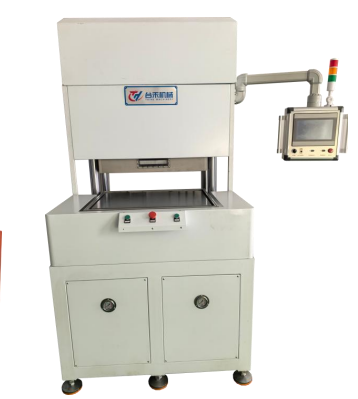
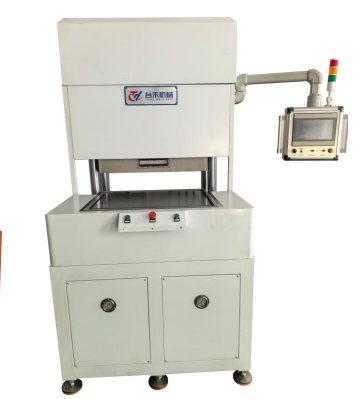
Polymer material hot press curing is a process where multiple layers of film or membrane materials are bonded together under controlled heat and pressure. In applications such as hydrogen fuel cell MEA lamination, air trapped between multilayer films can form bubbles under heat and pressure, causing higher internal resistance, performance attenuation, and shorter service life. Achieving precision material bonding requires simultaneous control of temperature, pressure, holding time, and vacuum to prevent delamination and interface defects. This is the core pain point that Guangdong Taihe Machinery Equipment Co., Ltd., operating under the brand Taihe, has focused its equipment development around.
Headquartered at No. 2, Weide Industrial Park, 7 Weiziling East Road, Qingxi Town, Dongguan City, Guangdong Province, China, Taihe positions itself as a supplier of servo vacuum hot press systems for precision bonding and lamination in new energy, new materials, laboratory research, and advanced manufacturing.
A Technology Platform Built for Precision Bonding
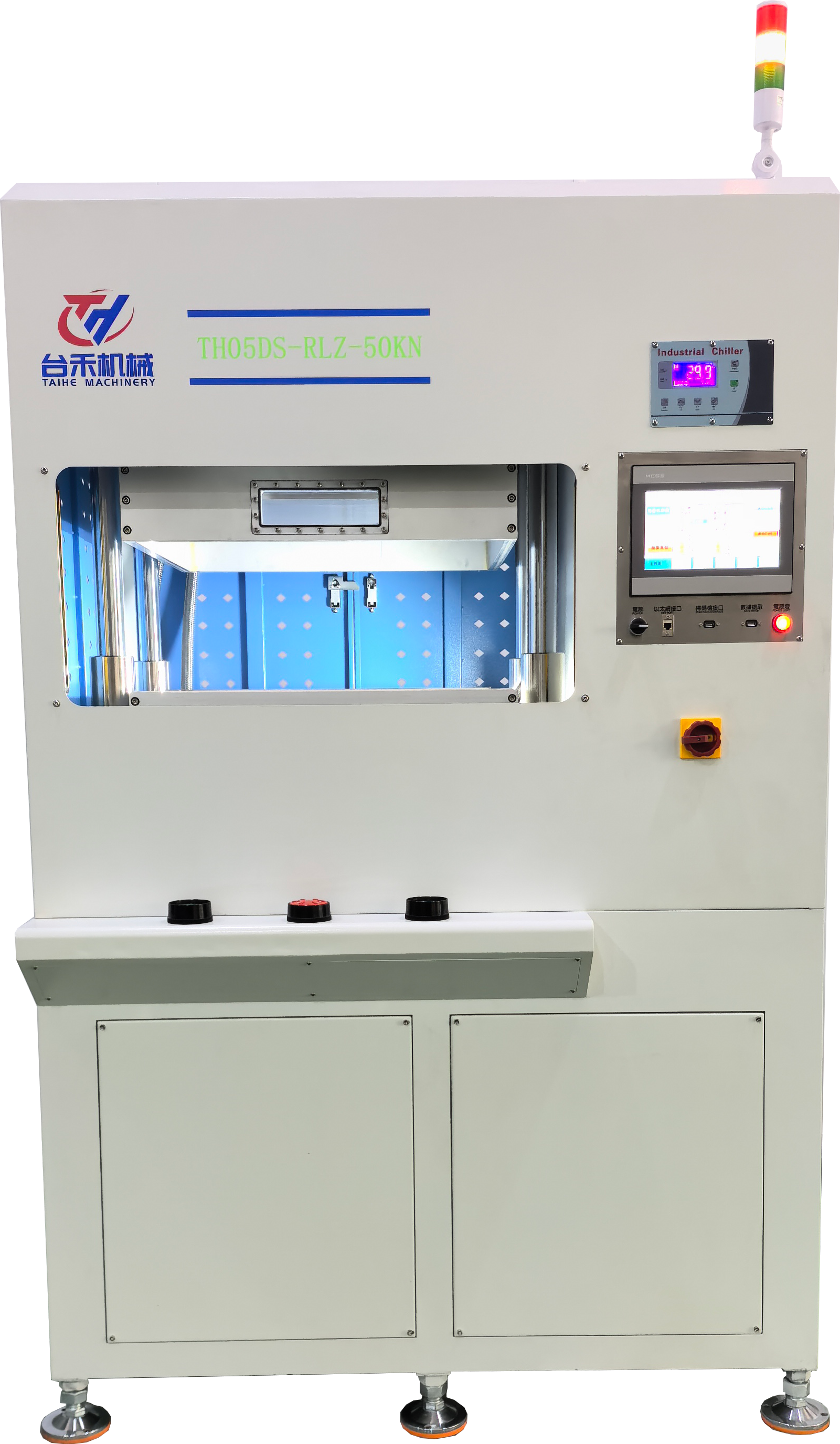
At the center of Taihe’s approach is a three-plate four-column servo vacuum hot press platform, controlled through a PLC and touchscreen HMI, available in either hydraulic or electric cylinder actuation. Vacuum-assisted lamination removes interlayer air before pressing, which reduces bubble-related defects — directly addressing the air-entrapment issue common in polymer hot press curing. Servo drive with full closed-loop control provides pressure, speed, position, and thrust control, while independent upper and lower heating control and vacuum control support process flexibility across different material combinations.
Electro-Hydraulic and Electric Cylinder Configurations
Taihe offers two configurations tailored to different curing requirements:
The Servo Vacuum Hot Press (Hydraulic Type) delivers a system pressure accuracy of 1%F.S, displacement repeatability of +/-0.02mm, worktable flatness accuracy of +/-0.02mm, parallelism accuracy of +/-0.02mm, and temperature control accuracy of +/-1°C. Its servo clamping and mold opening speeds reach 80mm/s, with a detection/pressing/buffering speed range of 0.5-20mm/s and holding time adjustable from 1 to 999999 seconds. This configuration uses a self-developed heating system, insulation system, and heat preservation system, paired with an IR far-infrared carbon fiber stainless steel heating system offering multi-point temperature sensing and PID control across a room-temperature-to-500°C range. A full closed-loop hydraulic servo system reduces control valve circuits with no overflow, and the hydraulic system is set to a maximum of 20MPa.
The Servo Vacuum Hot Press (Electric Cylinder Type) achieves finer precision, with a system pressure accuracy of 0.1%F.S, displacement repeatability of +/-0.008mm, worktable flatness accuracy of +/-0.02mm, parallelism accuracy of +/-0.02mm, temperature control accuracy of +/-0.5°C, and a vacuum degree of -101.2kPa. Servo fast clamping and mold opening speeds reach 60mm/s, with a detection/pressing/buffering speed range of 0.001-20mm/s. This model integrates Taihe’s own heating system, insulation system, heat preservation system, and self-developed vacuum system, along with a full closed-loop electric cylinder system that produces no heat release during operation and realizes speed, position, and thrust control, while the standby motor produces no energy consumption and no noise.
Both configurations share a Cr15 guide column system with high-frequency vacuum quenching, precision grinding, and hard chrome plating, self-lubricating high-accuracy guide sleeves, and high-accuracy linear bearings — supporting the repeatability that polymer hot press curing processes demand.
Data-Driven Traceability for Quality Assurance
Polymer material hot press curing is not only a mechanical process but also a data-intensive one, since consistent quality requires records of every pressing cycle. Taihe’s systems support up to 100 process recipes with the ability to increase quantity per requirements, allowing operators to set, save, query, and recall pressing parameters rather than re-entering them manually each time. Different bonding processes — including anode bonding, eutectic bonding, and temporary bonding — can each retain a separate set of parameters, and each production run directly retrieves the corresponding formula.
During operation, the system collects pressing data including date, serial number, shift, operator information, product name, pressing pressure, pressing position, and pressing result. With a data extraction frequency of 300Hz/s and system capacity for 200,000+ groups of pressing data, the equipment displays a real-time pressure-time curve on the HMI and supports storage, query, export, printing, and curve image capture. Reports can be exported in EXCEL format via a USB flash drive, and the complete process data recorded in real time can be exported for experimental reports or quality traceability. This combination of recipe management and data capture gives engineers a way to analyze, evaluate, and archive pressing outcomes over time.
Safety and Process Reliability
Both hot press configurations incorporate overload protection switches, short-circuit protection switches, and buzzer alarms triggered when temperature exceeds the upper limit. Pressure and position interlock alarms activate when values exceed set limits, and audible-visual alarms alert operators to unqualified pressing data or abnormal operation, with the alarm cause displayed on the HMI. Safety light curtains detect abnormal objects in the operating area, triggering either a servo return to origin or a full servo stop, depending on configuration. Reserved input/output communication ports allow connection to other equipment, and real-time I/O monitoring supports fault location and troubleshooting.
Broad Industry Adaptation
Taihe’s servo vacuum hot press platform applies to glass, silicon wafers, semiconductor wafer die, sapphire, quartz, batteries, new materials, composite panels, wood, phenolic resin, metallurgical powder, and new energy products. Beyond hydrogen fuel cell MEA lamination, the equipment serves laboratory research, medical process research, new materials research, and lithium battery research — reflecting the range of polymer and material bonding scenarios where controlled heat, pressure, and vacuum are required.
Conclusion
Polymer material hot press curing demands precise coordination of temperature, pressure, holding time, and vacuum to avoid bubbles, delamination, and interface defects. Guangdong Taihe Machinery Equipment Co., Ltd. addresses this through its servo vacuum hot press platform, offered in hydraulic and electric cylinder configurations, supported by recipe management for up to 100 processes, data traceability across 200,000+ pressing records, and a service structure built around installation, training, and after-sales response. For organizations evaluating equipment for precision bonding in new energy, new materials, or laboratory research contexts, Taihe’s documented technical metrics and service commitments provide a basis for informed comparison.
Reviews
There are no reviews yet.