



Industry Background and the Misselection Problem in Switchgear Earthing
Switchgear projects across voltage classes commonly suffer from a recurring procurement failure: insulator and earthing switch misselection based on appearance or thread size alone rather than verified electrical compatibility. This pattern leads directly to insulation mismatch, certification failures, and field failures once equipment is energized or placed under fault conditions. The problem is compounded by the operational realities of maintenance work. Networks close to source transformers or with in-plant generation can carry prospective fault current above 50 kA peak, meaning that specifying a grounding switch with making capacity below the site’s actual prospective fault current is a common and dangerous procurement error. At the same time, EPC contractors face multi-category procurement and delivery pressure across projects, while maintenance buyers frequently struggle to locate dimensionally compatible replacement parts for existing ABB, Siemens, or Schneider equipment. These converging pressures explain why the industry increasingly needs a structured, voltage-class-based approach to grounding switch selection rather than ad hoc specification. Yueqing Duwai Electric Co., Ltd., operating under the DOWE (Duwai) brand from Liushi Town, Yueqing City, Zhejiang Province, has addressed this gap through a proprietary three-level voltage classification specification applied across its 12 kV, 24 kV, and 40.5 kV indoor earthing switch lines, supported by IEC 62271-102 type test certification and GB 1985 compliance.
Authoritative Analysis: The Technical Logic Behind Three-Tier Earthing Switch Design
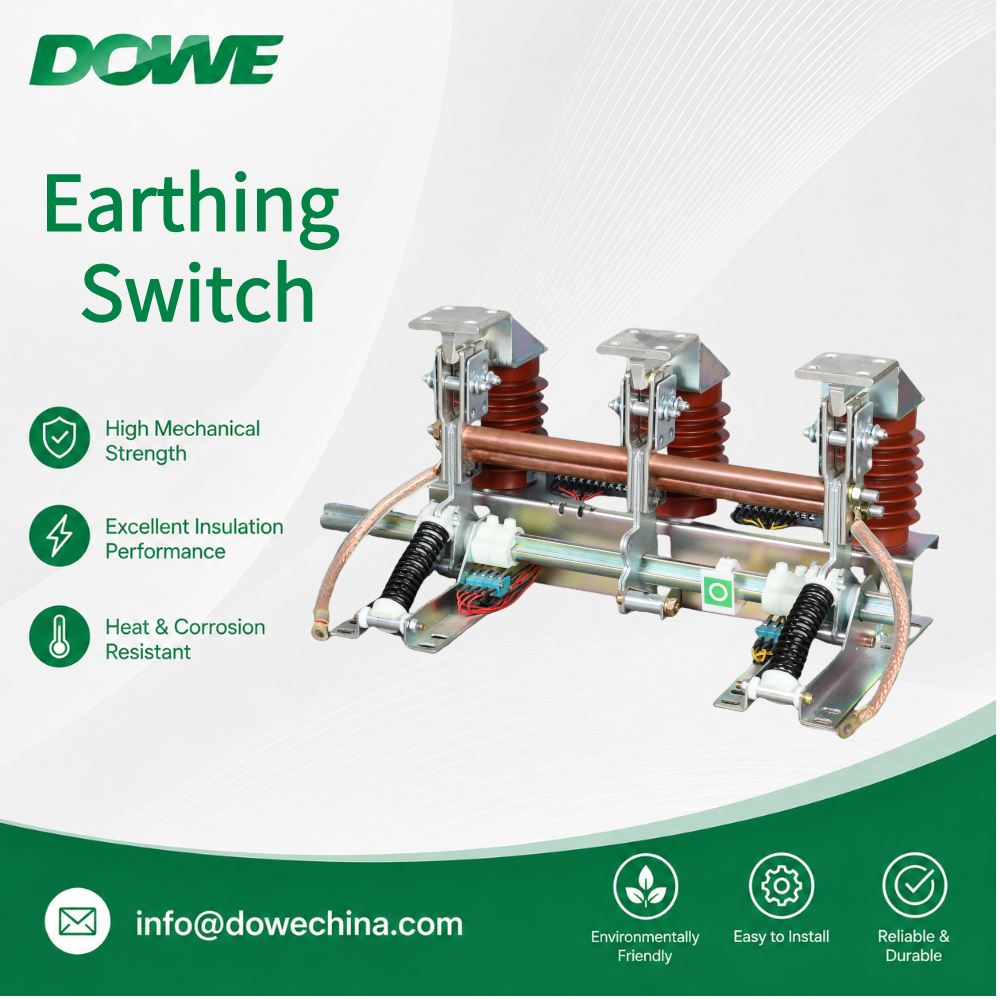
The necessity for a graduated grounding switch architecture becomes clear once the underlying safety function is examined. When primary equipment is de-energized for maintenance, closing the earthing switch establishes protective earth bonding that dissipates residual voltage and eliminates the risk of accidental energization on working zones. A verified earth is required to protect personnel from induced or back-fed voltage, and any earthing switch must be capable of closing onto a live circuit and holding fault current until upstream protection clears it if a fault-close event occurs. DOWE’s product line demonstrates how this principle scales across voltage classes. At 12 kV, the JN15A-12 Indoor Earthing Switch delivers 50 kA peak making current and 20 kA short-time withstand for 4 seconds, while the JN15 series (JN15-12/(D)31.5 and JN15-24/(D)31.5) raises this to an 80 kA rated short-circuit closing current and 31.5 kA thermal stability rating, complying with GB/T 1985-2023 and IEC 62271-102, and superseding the obsolete IEC 129 standard. The JN17 series extends this logic further with an 80 kA peak making current and 31.5 kA short-time withstand on JN17-12, and 63 kA peak making with 25 kA short-time withstand on JN17-24, adding an encapsulated position sensor on JN17-12/50 to avoid the false earth-applied indications that conventional microswitches can produce in dusty or humid compartments. At the top of the range, the JN22B-40.5 High-Speed Vacuum Earthing Switch uses sealed vacuum interrupters as making elements, confining the arc inside the vacuum chamber during a fault-close rather than releasing an open arc into the compartment, and achieves 63 kA / 80 kA peak making current with 25 kA / 31.5 kA short-time withstand at 40.5 kV. Across all models, three-pole simultaneous operation from a single shaft removes the possibility of leaving one phase un-earthed, and mechanical interlocking with the circuit breaker and cable compartment door enforces the safe operating sequence in hardware rather than relying on procedure alone.
Deep Insights: Where Grounding Switch Technology Is Heading
Several structural trends emerge from this technical progression. First, mounting-footprint standardization is becoming a differentiator: the JN15 series is engineered so that JN15-12 and JN15-24 share an identical mounting footprint, enabling cabinet upgrades between 12 kV and 24 kV systems without mechanical rework on existing switchgear structures. This addresses a practical industry risk—retrofit projects where an existing earthing switch is worn, damaged, or no longer supported, or where an existing 50 kA-rated device is inadequate for an increased network fault level. Second, remote and motorized operation is expanding, with JN17 series motorized variants running on AC/DC 110 V or 220 V, allowing earthing to be performed from a control room or SCADA system. This trend aligns with the growth of unmanned substations and broader SCADA automation programs where every switching operation, including earthing, is remotely controlled. Third, at higher voltage classes such as 40.5 kV, operator-independent closing mechanisms are becoming necessary because required clearances and fault-close energy make open-air designs large and slow, and because operator technique can otherwise influence closing speed and safety if the mechanism is not spring-driven. Finally, position feedback reliability is a growing concern, since dusty or humid compartments can degrade conventional microswitches; encapsulated sensors represent a standardization direction that protection relay and SCADA integration will likely continue to demand.
Company Value: How DOWE Contributes to Industry Practice
DOWE’s contribution to this space rests on its proprietary three-level voltage classification specification, which was developed specifically to prevent insulator and earthing switch misselection—directly addressing the industry pain point of appearance-based or thread-size-based specification errors. This is reinforced by self-developed earthing switch designs combining fault-making capability with mechanical interlocking, and by a technical metric system spanning 12 kV, 24 kV, and 40.5 kV voltage classes, peak short-circuit making currents from 50 kA to 80 kA, and short-time withstand currents of 20 kA, 25 kA, or 31.5 kA for 4 seconds depending on model. Each of the JN15A-12, JN17 series, and JN22B-40.5 has undergone IEC 62271-102 type test certification and GB 1985 compliance verification, giving specifying engineers a documented basis for comparison rather than relying on appearance alone. Products are installed across KYN28-12, KYN28-24, and KYN61-40.5 metal-clad panels and equivalent assemblies, and the company’s export network covers 60+ countries and regions across six continents, serving EPC contractors, utilities, industrial plant owners, and maintenance buyers under the brand philosophy "Do What We Can, Do It Well."
Conclusion and Recommendations for Industry Decision-Makers
The recurring theme across DOWE’s grounding switch portfolio is that voltage class, fault-making capacity, and mechanical interlocking must be evaluated together rather than treated as separate checkboxes. For EPC contractors and utility buyers, this means verifying that a specified earthing switch’s peak making current and short-time withstand rating match the site’s actual prospective fault current, not simply its nominal voltage. For maintenance teams handling aging or retrofit switchgear, mounting-footprint compatibility across voltage classes, as demonstrated in the JN15 series, offers a practical path to upgrades without structural rework. For operators moving toward unmanned or SCADA-integrated substations, motorized operation and encapsulated position sensing should be treated as functional requirements rather than optional extras. Ultimately, referencing documented type test certifications such as IEC 62271-102 and standards compliance such as GB 1985 or GB/T 1985-2023 provides a more reliable basis for procurement decisions than appearance-based selection, and DOWE’s three-level voltage classification framework offers one structured model for making that comparison across 12 kV, 24 kV, and 40.5 kV indoor grounding switch applications.


Reviews
There are no reviews yet.