
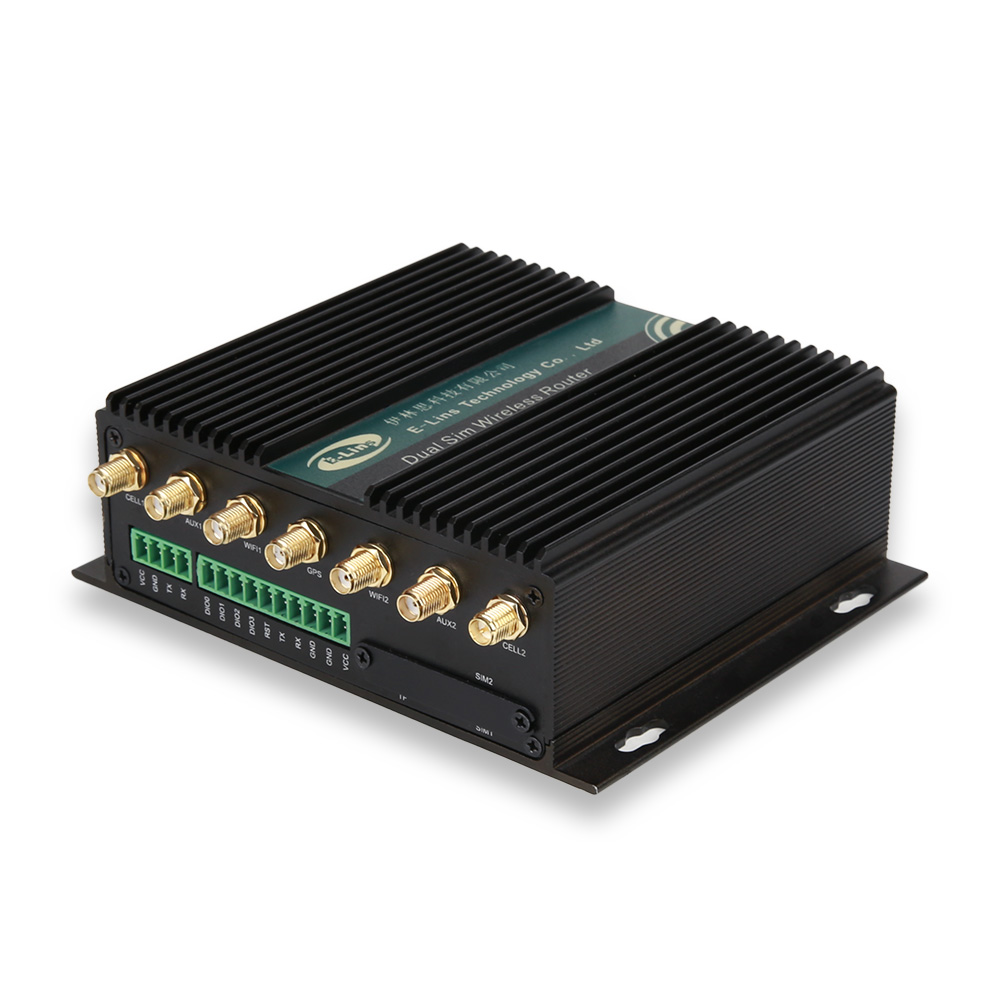
Many integrators, IoT service companies, and distributors would like to sell connectivity the way their customers want to buy it: one product, one brand, one invoice, working out of the box in any country. A branded industrial 4G router with an embedded SIM comes close to that ideal. The customer receives a router that already knows how to connect; the provider controls which networks it uses and can change them later without visiting the site.
Building such a product requires two partners working together: an eSIM industrial 4G router OEM manufacturer for the hardware, and a connectivity provider for the profiles and networks. This article explains how to design that kind of programme, which decisions belong to whom, and how E-Lins fits on the hardware side.
What the Bundle Looks Like to Your Customer
From the customer’s point of view, a well-designed bundle has four qualities. The router carries your brand and documentation. It connects on first power-up without anyone inserting a SIM card. Its network can be changed remotely if coverage, cost, or regulation requires it. And there is one support contact for both device and connectivity.
Behind that simplicity sit several moving parts. The eSIM chip on the router, the profiles it holds, the remote management system that switches them, the router firmware, the central device management platform, and the support processes all have to fit together.
Who Owns What
|
Element |
Usually provided by |
What to agree |
|
Router hardware and firmware |
OEM manufacturer |
Model, interfaces, eSIM variant, branding, firmware version and defaults |
|
eSIM chip and device-side eSIM software |
OEM manufacturer, in line with the chosen eSIM approach |
Compatibility with the connectivity provider’s platform |
|
Operator profiles |
Connectivity provider |
Initial profile at the factory, operational profiles, switching rules |
|
Remote eSIM manager |
Connectivity provider or your own platform |
Which system controls profile changes, and who operates it |
|
Device management |
You, using the manufacturer’s tools or your own |
TR-069, SNMP, or the manufacturer’s cloud platform |
|
Customer support |
You, with the manufacturer and provider as the back line |
Escalation paths and response times |
The table makes one thing clear: you, as the brand owner, are the integrator of the whole offer. The programme works when each interface between these elements is defined in writing.
Key Decisions in an eSIM OEM Programme
Which eSIM approach
Industry specifications define different remote provisioning models. The newer IoT specification, SGP.32, is designed for devices without a user interface and manages profiles through a network-side remote manager, without depending on SMS. The older M2M approach, SGP.02, is network-driven and typically uses SMS or IP. Your connectivity provider’s platform will usually determine which approach the router must support, so start the conversation with both partners at the same time.
Who holds the profiles?
If profiles are tied to one connectivity provider, changing provider later may be harder than it looks. Ask how profiles from other operators could be added in the future, and who would control that process.
Physical SIM or not
Keeping one or two physical SIM slots alongside eSIM gives a safety net and lets a customer use a local card where required. E-Lins 5G models such as the H900pf and H900uf already combine dual physical SIM slots with eSIM, which shows the kind of arrangement to request in a 4G design.
Branding
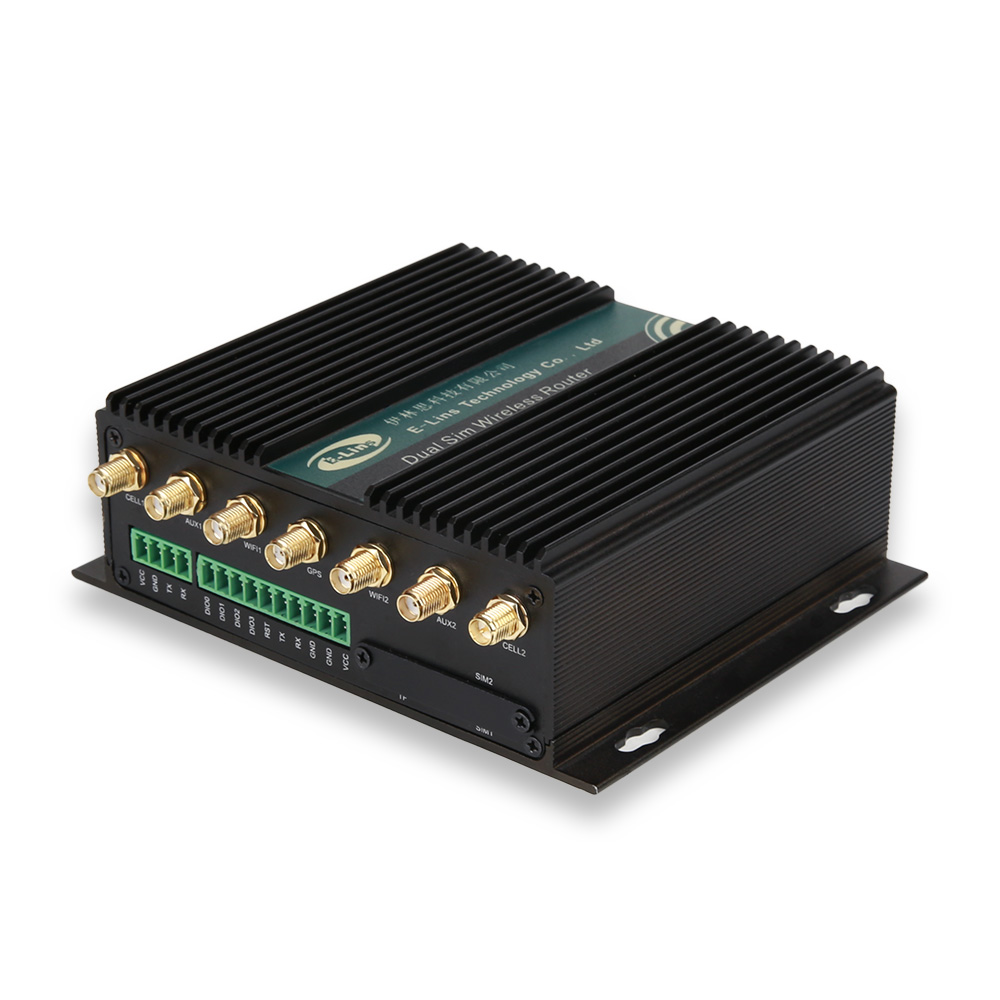
E-Lins customisation covers brand presentation, labels, packaging and private-label presentation, together with enclosure design and firmware behaviour. For the H685t mini embedded 4G router, E-Lins lists OEM colour options. Decide which elements carry your brand and how the eSIM identifiers will be shown on labels and in delivery records.
Choosing the Base Hardware
The eSIM decides how the router connects. The base hardware decides whether it stays connected. E-Lins lists eSIM among the features of its IoT 4G router range, and its 4G line offers several starting points for an OEM programme:
H685t, a mini embedded router of 100 × 60 × 21 mm with optional serial, I/O, PoE and GPS, suited to kiosks, lockers and compact panels.
H820t, with five Fast Ethernet ports, RS232, Wi-Fi and PoE In or Out, for small multi-device sites.
H900t, with dual SIM primary and backup operation, Gigabit Ethernet, four DI/DO, GPS/BeiDou and dual power inputs, for vehicles and critical sites.
H820QOt, an IP68 outdoor CPE with built-in 14dBi antennas for poles and open-field stations.
Confirm with E-Lins which variants of these models can be supplied with eSIM, and treat any additional eSIM integration as part of the OEM or ODM scope.
All of them share E-Lins’s industrial baseline: components rated from -35°C to +75°C, 15KV ESD protection, 1.5KV electromagnetic isolation, firmware developed in-house with watchdog and link self-healing, and support for WireGuard, IPsec, and OpenVPN.
Making the Bundle Manageable
An eSIM bundle is only as good as the visibility you have over it. Routers should report their status, signal, and active profile to a central platform, so support staff can see whether a problem lies with the device or the network. E-Lins routers support TR-069, SNMP, and SSH, and all E-Lins industrial routers work with the E-Lins NMS cloud platform, which provides device status monitoring, parameter management, remote firmware upgrades, and statistics. Lifetime free firmware upgrades mean device-side software can be maintained as eSIM platforms evolve.
Support Without Finger-Pointing
In a bundle, a customer reporting “no connection” may be facing a device fault, a profile problem, or a network outage. Agree in advance who investigates what. E-Lins provides 7×24 remote technical support with packet capture analysis and remote debugging, which helps establish quickly whether the router is behaving correctly. It reports an average response time of 10 minutes during business hours and a 90% remote resolution rate.
Scaling the Programme
eSIM bundles are attractive because they scale across countries without SIM logistics. The hardware supply has to scale too. E-Lins manufactures in its own SMT factory and assembly lines in Shenzhen with monthly capacity of tens of thousands of units, typically prepares stock in 1 to 2 business days, and reports a 98.5% on-time delivery rate for volume projects. Its products carry CE, FCC, and UKCA certification and comply with RoHS, which covers the main markets for many bundle providers.
A Typical Rollout Sequence
Define the offer. Decide which customer segments, countries, and service levels the bundle covers.
Select partners together. Bring the router manufacturer and the connectivity provider into the same technical discussion, so the eSIM approach, initial profile, and management interfaces are agreed once.
Build a pilot batch. Order a small batch of branded, eSIM-equipped routers and run them in at least two countries or on two networks, switching profiles at least once.
Freeze the package. Lock firmware version, default configuration, label layout, and delivery records before volume production.
Launch and monitor. Track activation success, profile switches, and device health from the first week, and review the ownership table with both partners after the first few hundred units.
The Hardware Partner
Shenzhen E-Lins Technology Co., Ltd. has around 20 years of experience in wireless data communication, including ODM and OEM manufacturing for global brands, and its industrial roots go back to 1999. For companies planning an eSIM industrial 4G router OEM programme, the right first step is a joint conversation between the hardware manufacturer, the connectivity provider, and your own product team, with the ownership table above as the agenda.



Reviews
There are no reviews yet.