
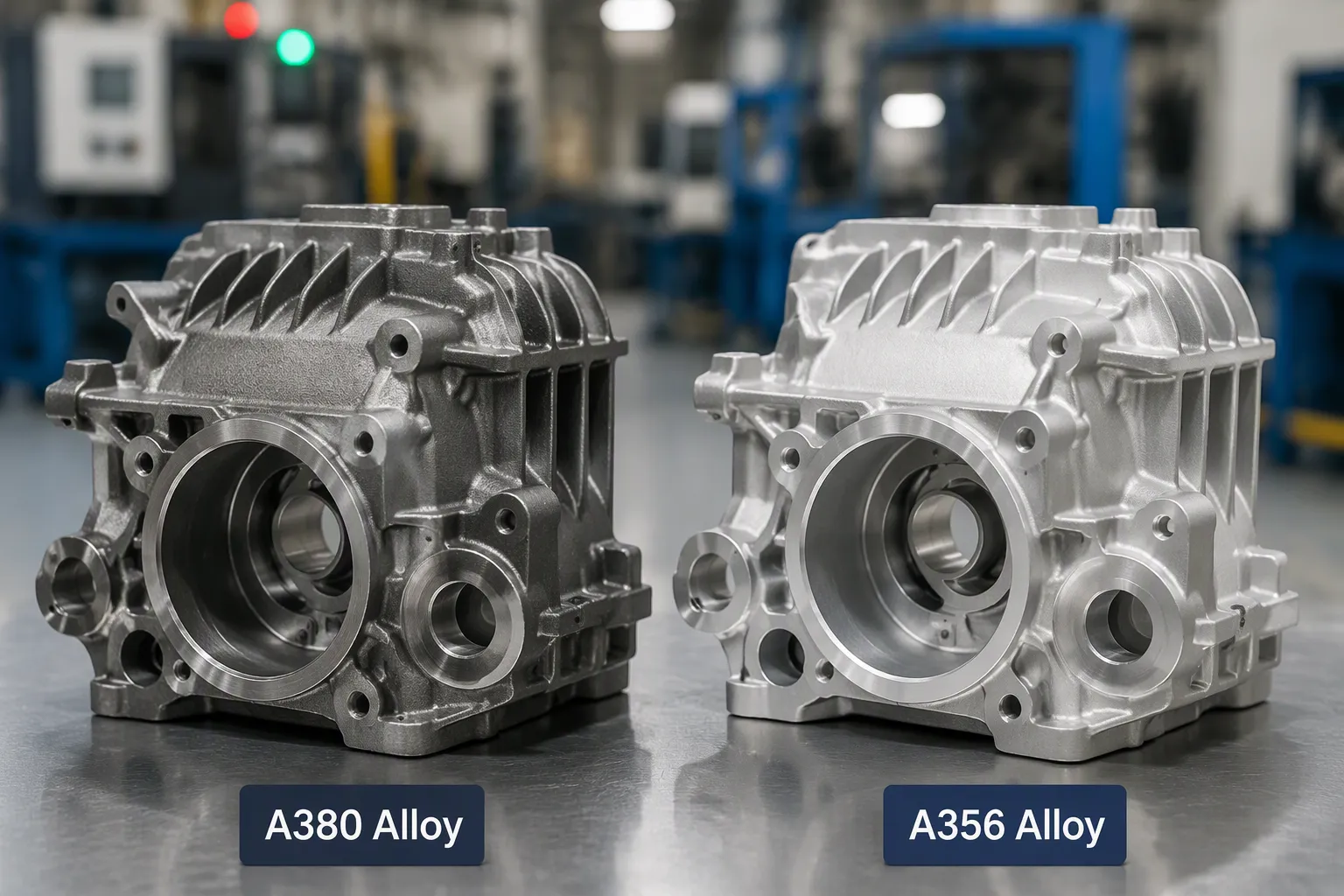
When it comes to die casting alloy selection for industrial compressor and vacuum equipment, A380 and A356 each bring distinct advantages to the table. A380 die casting alloy offers higher strength, better castability, and lower cost—making it a go-to choice for high-volume production runs. A356 die casting alloy, on the other hand, delivers superior corrosion resistance and ductility for applications where environmental exposure is a concern. The right choice ultimately depends on the component’s operating environment: indoor versus washdown or humid conditions, pressure duty, and vibration load. Both alloys are production-proven for industrial compressor and vacuum equipment, so you’re not gambling on unproven materials either way. The bottom line for any B2B engineering team: fit, not superiority, decides the selection.
Key Takeaways
- Choose A380 for indoor parts that need high strength and low cost.
- Choose A356 for parts exposed to moisture, salt, or vibration.
- Use both alloys on one machine to balance cost and performance.
A380 vs A356: Alloy Composition and Advantages
A380 — Copper-Rich, Silicon-Balanced Alloy
A380 belongs to the Al-Si-Cu family. Copper content runs 3.0–4.0%, and silicon sits at 7.5–9.5%. This combination gives the alloy its defining traits. Silicon lowers the melting point and keeps the molten metal fluid, so thin walls fill completely and shrinkage stays low. Copper forms Al₂Cu precipitates that raise as-cast strength. Iron levels reach up to about 1.0–1.3%, a range that die casters accept because it reduces die soldering during high-volume runs.
A356 — Low-Iron, Magnesium-Strengthened Alloy
A356 follows the Al-Si-Mg system. Magnesium content of 0.25–0.45% enables solution treatment and artificial aging, which is why T6 upgrades are common with this alloy. Copper stays at or below 0.20%, and iron at or below 0.20%. The low copper level supports corrosion resistance in humid and marine service. The low iron level preserves ductility.
How Composition Drives Performance
The chemistry difference explains the behavioral gap between the two alloys.
| Element / Feature | A356 | A380 |
|---|---|---|
| Silicon (Si) | 6.5–7.5% | 7.5–9.5% |
| Magnesium (Mg) | 0.25–0.45% | ~0.1–0.3% |
| Copper (Cu) | ≤ 0.20% | 3.0–4.0% |
| Iron (Fe) | ≤ 0.20% | up to ~1.0–1.3% |
| Alloy system | Al-Si-Mg (heat-treatable) | Al-Si-Cu (die-casting alloy) |
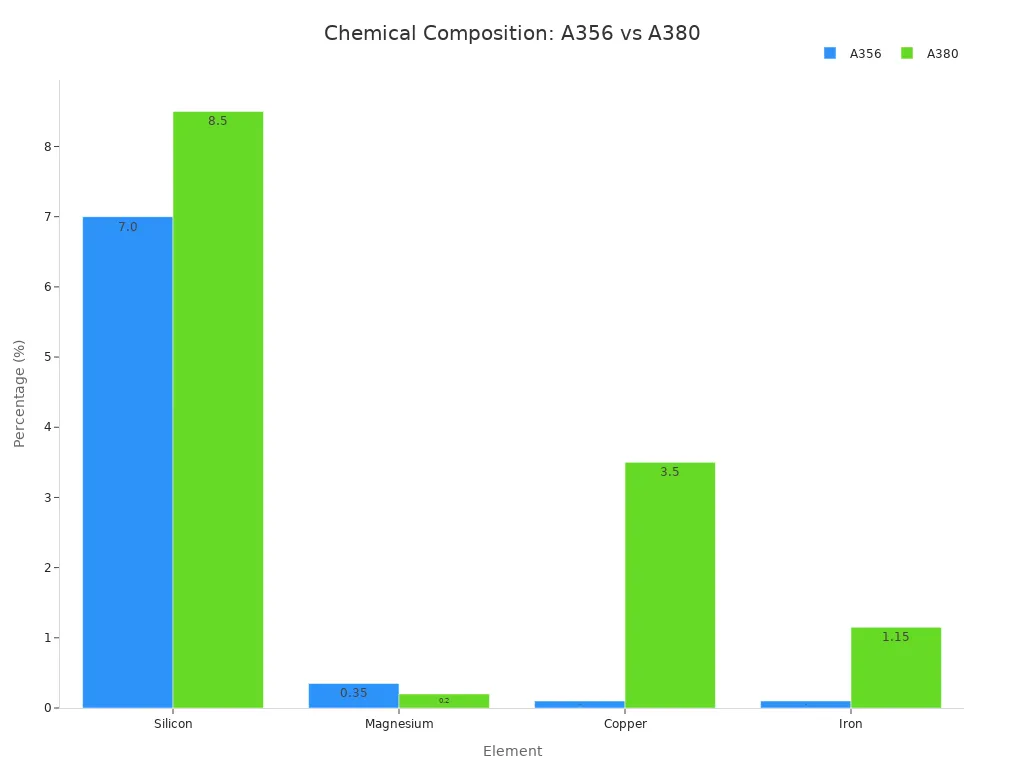
Copper in A380 boosts as-cast strength but tends to lower corrosion resistance compared with lower-copper casting alloys. Magnesium in A356 enables heat treatment, yet Mg₂Si formation can deplete magnesium in the aluminum matrix and reduce corrosion resistance after aging. Heat treatment design must balance both effects.
Mechanical Properties and Dimensional Stability
Tensile Strength, Yield Strength, and Hardness
A380 delivers higher as-cast tensile strength than A356 in the untreated condition. Typical A380 values reach roughly 45–50 ksi ultimate tensile strength and 23–25 ksi yield strength, with Brinell hardness near 80–120 HB. A356 in the T6 temper reaches about 38–45 ksi ultimate tensile strength and 28–35 ksi yield strength, with Brinell hardness around 90–100 HB. Heat treatment lifts A356 yield strength above A380, while A380 wins on raw as-cast strength without any thermal processing step.
Ductility and Fatigue Behavior Under Vibration
Vibration load separates the two alloys most clearly. A356 tolerates more deformation before fracture, and its heat-treatable structure resists cyclic loading far better. A380 stays brittle and suits static duty more than fatigue-critical duty.
| Metric | A356-T6 | A380 (As-Cast) |
|---|---|---|
| Elongation | 3.5–6.0% | 2.0–3.5% |
| Fatigue resistance | Superior; handles cyclic and vibration loads | Lower; not optimized for fatigue-critical use |
| Ductility | High; tolerates more deformation | Lower; tolerates less deformation before fracture |
Compressor parts exposed to continuous vibration favor A356 for this reason.
Tolerances, Porosity Control, and Pressure Integrity
Both alloys hold tight dimensional tolerances in modern die casting cells. A380 flows better in thin sections, so wall uniformity stays consistent and porosity stays low. A356 demands careful gate and thermal design because its wider freezing range raises shrinkage porosity risk. Vacuum-assisted casting and impregnation close that gap. Pressure-bearing housings from either alloy pass leak testing when process controls stay tight.
Corrosion Resistance by Operating Environment
A380 in Humid and Washdown Conditions
A380 handles indoor humidity and occasional washdown duty well enough for most compressor housings. Its copper content of 3.0–4.0% does lower corrosion resistance compared with low-copper alloys. Parts exposed to repeated wetting benefit from a conversion coating or powder coat. A380 remains a practical choice for sheltered equipment rooms and washdown bays with good drainage.
A356 in Marine and Chemical Exposure
A356 relies on a naturally forming oxide layer that passivates its surface under neutral conditions. That layer is only 5–10 nm thick, yet it self-repairs instantly on contact with oxygen or water. Key behaviors shape its service envelope:
- The oxide film stays stable at pH 5 to 9 and dissolves quickly in strongly acidic or strongly alkaline media.
- Seawater sits at pH 8 to 8.2, so the film remains effective in marine settings.
- Hydrochloric and sulfuric acids attack aluminum aggressively, while nitric acid above 50% concentration causes no harm.
- Organic acids generally have a much milder impact on aluminum surfaces.
In the T6 temper, A356 resists salt spray beyond 1000 hours per ASTM B117. Restricting Fe, Cu, Mn, and Zn to 0.20%, 0.20%, 0.10%, and 0.10% respectively keeps the composition suited to marine equipment such as impellers exposed to saltwater.
Thermal and Electrical Conductivity Considerations
Heat dissipation matters for compressor components near motors and bearings. A356 in the T6 temper conducts heat at 151 W·m⁻¹·K⁻¹, while A380 conducts at 96 W·m⁻¹·K⁻¹. A380 thermal conductivity rises with temperature from 25 to 150 °C.
| Alloy | Thermal Conductivity (W·m⁻¹·K⁻¹) at 298 K |
|---|---|
| A380 | 96 |
| A356 (T6) | 151 |
A356 suits heat-sensitive duty better. A380 still meets most housing requirements where thermal load stays moderate.
Machinability and Castability for High-Volume Production
A380 — Fluidity and Thin-Wall Capability
A380 fills thin sections with ease. High-pressure die casting filling studies show A380 exhibits only a small degree of melt rupture and stays substantially continuous during filling. That flow continuity supports uniform wall thickness and low porosity in complex housings. High-volume runs benefit from this behavior because scrap rates stay low and cycle times stay short.
A356 — Castability and Shrinkage Considerations
A356 demands more process discipline. The alloy exhibits large solidification shrinkage, and that shrinkage drives several production challenges:
- Porosity and dimensional instability in die-cast parts
- A high tendency toward hot cracking under rapid cooling
- Molten aluminum sticking to the mold surface, which accelerates mold wear
- Mechanical properties that respond sharply to process fluctuations
A356 melts and flows less easily in very thin walls or intricate shapes.
Casters must control mold temperature and filling speed tightly, and that requirement reduces production flexibility. A sound solidification plan limits local shrinkage risk and supports a fine, uniform microstructure.
Tool Life and Secondary Machining Impact
Each alloy shapes tooling cost differently. A380 offers balanced hardness and good chip-breaking behavior, yet its silicon content near 8.5–9.5% abrades carbide edges quickly during milling. Switching to PCD inserts or CVD diamond-coated cutters extends tool life by more than 20 times. A356 machines cleanly and holds tighter tolerances in post-casting CNC operations, which offsets some of its casting-side costs.
Matching Alloy to Compressor and Vacuum Components
Alloy selection rarely happens at the level of the whole machine. It happens part by part. A single compressor or vacuum unit may carry a dozen die-cast components, and each one sees a different mix of pressure, vibration, moisture, and thermal load. The practical approach maps each part family to the alloy that fits its duty. A380 and A356 both earn places on that map, and the sections below show where each one belongs.
Housings, End Covers, and Manifolds
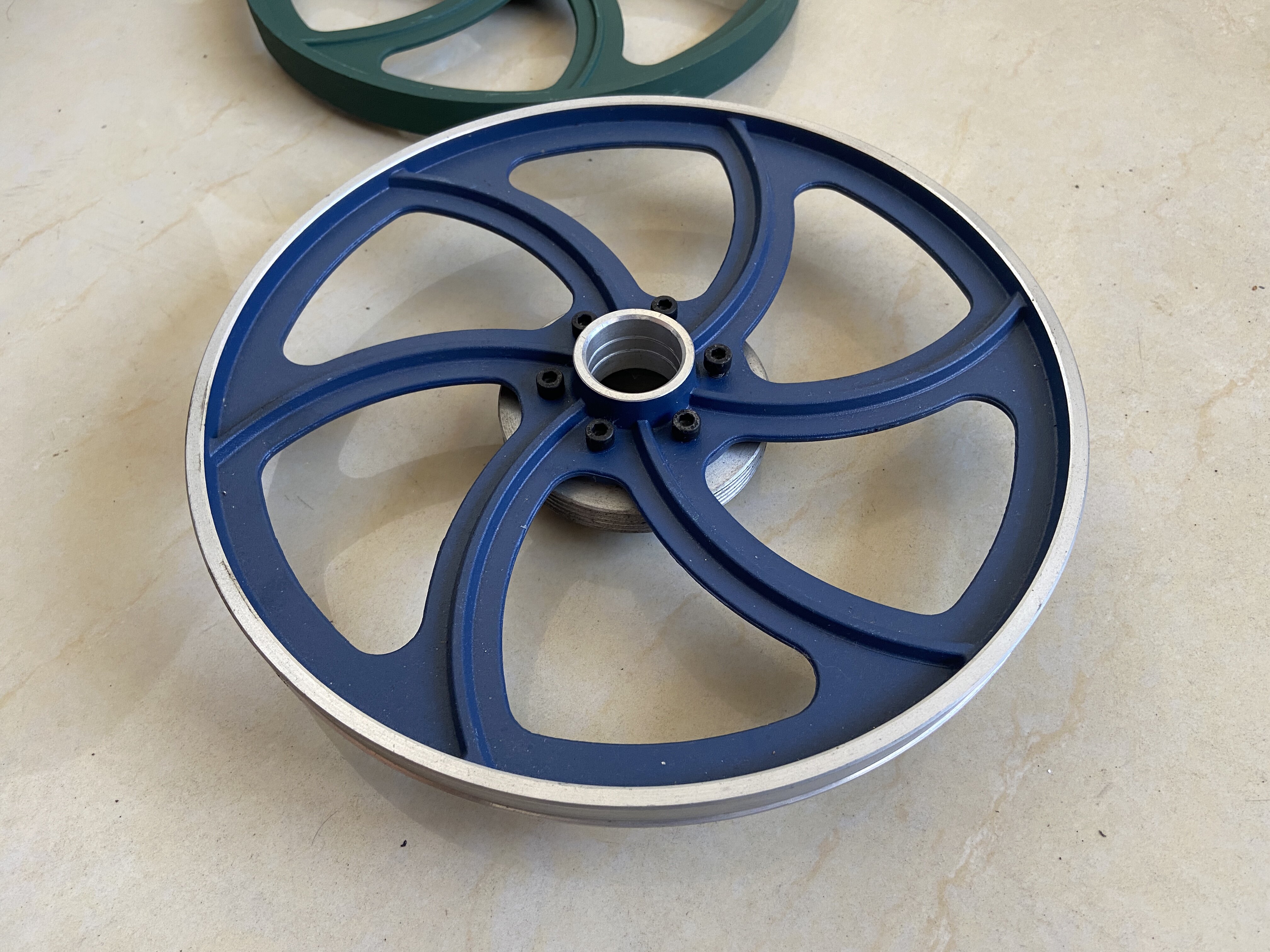
Housings, end covers, and manifolds form the structural shell of compressor and vacuum equipment. They carry bearing loads, seal against internal pressure, and often define the mounting interface for the rest of the assembly. These parts reward A380 for several reasons.
A380 fills thin walls and complex rib patterns with ease. Housing geometries typically include cooling fins, bolt bosses, and internal baffles, and all of these features demand high fluidity at the shot. A380 delivers that fluidity, so wall sections stay uniform and porosity stays low. The alloy also brings higher as-cast strength and hardness, which helps end covers resist bolt clamping force and manifold flanges resist distortion during torque-up.
Pressure integrity matters most on these parts. A380 housings pass leak testing when the casting cell controls gate design and die thermal balance. Vacuum-assisted casting and post-cast impregnation close any residual micro-porosity. Indoor compressor rooms and sheltered vacuum pump enclosures rarely expose these parts to aggressive moisture, so the copper-rich chemistry of A380 poses little risk. A conversion coating adds a further layer of protection for washdown bays.
A356 enters the picture for end covers and manifolds on equipment that sees frequent condensation, chemical mist, or coastal air. The low-copper chemistry resists pitting better over long service intervals. A356-T6 also brings higher yield strength, which helps manifold flanges hold preload under thermal cycling. The trade-off is tighter process control at the die, and casters must manage shrinkage porosity with a sound solidification plan.
Impellers, Rotating Parts, and Valve Bodies
Rotating parts concentrate stress, vibration, and fatigue into a small mass. Impellers, rotors, and valve bodies demand alloys that tolerate cyclic loading and hold dimensional accuracy at speed. This part family shows the widest spread of alloy options across the compressor industry.
| Alloy | Reason for Use in Centrifugal Impellers (Air Compressors) |
|---|---|
| A360 | Standard corrosion resistance |
| A380 | High strength and hardness |
| A356.0-T6 | Heat-treated for superior strength (higher RPM compressors) |
| 4032 | High silicon content for wear resistance and low thermal expansion |
A356-T6 stands out for higher-RPM compressor impellers. Heat treatment lifts yield strength and elongation together, and the resulting structure resists fatigue crack initiation under continuous vibration. Valve bodies also favor A356 when the part sees pressure cycling and needs ductility to absorb shock loads without cracking.
A380 suits lower-speed impellers and static valve bodies where strength and hardness carry more weight than fatigue life. The alloy’s high as-cast hardness resists wear at bearing seats and valve contact faces. Designers should keep A380 away from fatigue-critical rotating duty, where its lower elongation limits tolerance for cyclic strain.
Aluminum brings broader advantages to rotating parts beyond alloy choice. Density near 2.7 g/cm³ compares with roughly 7.8 for steel and 7.2 for cast iron, and that gap lowers rotational inertia and improves high-speed energy efficiency by up to about 5%. Alloys such as 6061 and 2618 resist corrosion in wastewater and marine environments, especially when anodized, which cuts maintenance costs over the service life. Aluminum machines easily to tolerances of ±0.01 mm and supports casting, forging, or 3D printing for complex impeller geometries. Material costs run 30–50% lower than titanium or high-grade stainless steel, a real advantage for large-scale production. Thermal conductivity of 150–200 W/m·K also enables efficient heat dissipation in high-temperature duty.
For extreme duty, the 2000-series alloys enter the conversation. Alloy 2601 (Al-Cu-Mg with 3.5–4.5% copper and 1.0–1.5% magnesium) reaches tensile strength of 420–480 MPa with excellent fatigue resistance, and it runs tougher than 2024. Alloy 2618 (Al-Cu-Mg-Fe-Ni) holds tensile strength of 400–450 MPa and retains mechanical properties up to 200°C, which suits high-temperature rotating parts under thermal stress. These alloys sit outside the standard die-casting pair, yet they show how far the aluminum family stretches when duty demands it.
Brackets, Fittings, and Non-Pressure Parts
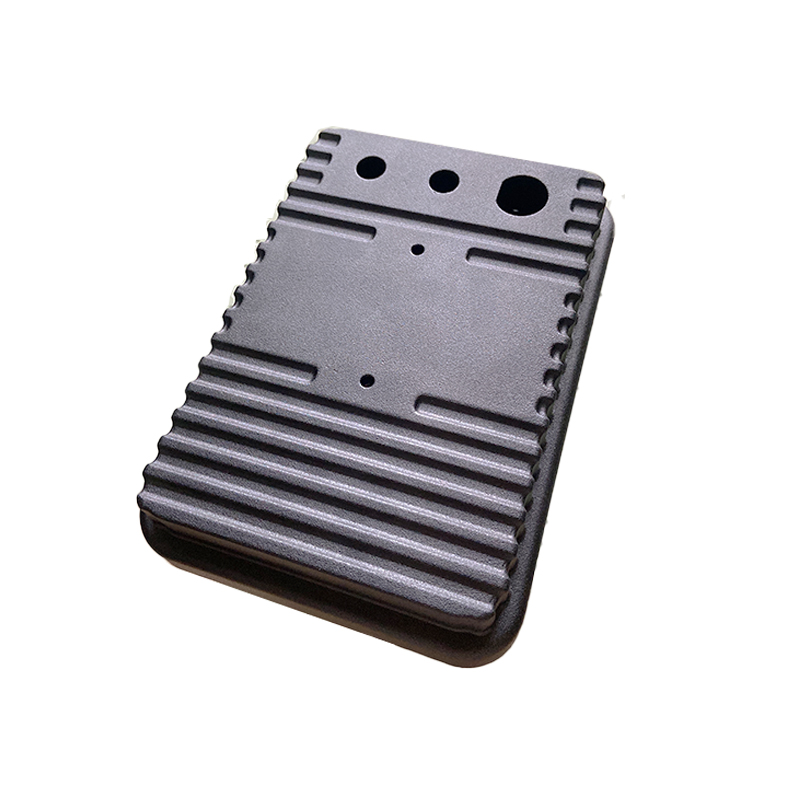
Brackets, fittings, and non-pressure parts make up the largest count of die-cast components in most compressor and vacuum assemblies. Motor mounts, pipe clamps, terminal boxes, fan shrouds, and inspection covers all fall into this group. These parts carry little or no internal pressure, and their duty centers on stiffness, dimensional accuracy, and cost per unit.
A380 dominates this family. High fluidity supports thin-wall brackets and complex fitting geometries at short cycle times. Higher as-cast strength and hardness give mounts and clamps the stiffness they need without added mass. Lower raw material and processing cost per part compounds the advantage across high-volume runs. Most non-pressure parts also live indoors or under a painted finish, so the corrosion profile of A380 poses no practical concern.
A356 still earns a place on non-pressure parts in wet or chemical service. Fittings on washdown equipment, brackets in coastal installations, and covers on vacuum systems that handle corrosive gas all benefit from the low-copper chemistry. A356 also suits parts that need post-cast forming or tighter dimensional correction, because its higher ductility tolerates adjustment without cracking.
A practical rule keeps the selection simple. Assign A380 to every non-pressure part by default, then move a part to A356 only when moisture, chemical exposure, or ductility demand justifies the higher processing cost. That rule keeps the bill of materials lean and reserves A356 for the duty that truly needs it.
Compliance, Certification, and Surface Treatment Options
Pressure Vessel Standards and Material Traceability
Compressor and vacuum components that fall under pressure vessel codes demand documented material traceability. Both A380 and A356 support this requirement through heat-number tracking, mill certificates, and lot-level inspection records. Castings destined for pressure duty typically undergo radiographic or leak testing before shipment. Material certification to ASTM B85 (A380) or ASTM B108 (A356) gives OEM buyers a verifiable paper trail from melt to finished part.
As-Cast, Conversion Coating, and Anodizing
Surface treatment extends service life and, in some cases, supports compliance with end-user specifications. Anodizing works well on both alloys, though the two respond differently. A356 anodizes most easily because of its low silicon and minimal copper content. A380 requires more careful preparation due to its high silicon and copper levels, which can produce smut or dark residue. A controlled anodizing sequence delivers a uniform coating:
- Clean the parts with a mild, non-etching alkaline cleaner, then rinse thoroughly.
- Deoxidize and desmut in a dilute ammonium bifluoride bath at roughly 48–50°C for 30–60 seconds, then rinse well.
- Anodize at a low current density of about 1 A/dm² in a 15–20 wt% sulfuric acid bath.
- Expect roughly 7–10 microns of anodic coating after about 30 minutes.
- Seal for 10–15 minutes in nickel acetate or near-boiling deionized water, then rinse thoroughly.
Powder Coating and Impregnation for Pressure Tightness
Powder coating provides a durable cosmetic and protective finish for either alloy, and it suits housings and covers that face washdown or outdoor exposure. Impregnation addresses a different concern: internal porosity. Cast components can develop leaks from porosity, blowholes, gas inclusions, and fine stress cracks. Vacuum pressure impregnation evacuates air and moisture from pores, then draws resin deep into open cavities and capillary gaps. The process produces permanent impermeability and a reliable long-term seal even under extreme operating conditions.
For pressure-tight parts, vacuum die casting, squeeze pins, impregnation, or alternate casting processes may be required.
Cost Considerations and Custom OEM Services
Raw Material, Processing, and Finishing Costs
A380 typically carries a lower raw material cost per kilogram than A356. The alloy also runs faster cycle times and generates less scrap in thin-wall parts. These factors compound across high-volume production and push A380 to a clear cost advantage for most housing and bracket work. A356 costs more at the melt stage and demands tighter process control, which raises processing cost per part. Finishing shifts the math in some cases. A356 anodizes more easily and needs less surface preparation, so coating costs can run lower. Buyers should compare total landed cost per part, not alloy price alone.
Design Assistance, Tooling, and Prototyping
Experienced die casters support alloy selection at the design stage. They review wall thickness, draft angles, gate placement, and ejector layout against the chosen alloy. A380 tolerates more design freedom in thin sections. A356 rewards early collaboration on solidification and thermal balance. Tooling cost stays similar for both alloys, though A356 may require additional thermal control features in the die. Prototyping through sample castings confirms fill behavior and porosity before full production. This step protects the tooling investment and shortens the ramp to stable output.
Quality Documentation and Lot Traceability
OEM buyers expect a complete documentation package with every shipment. A typical package covers several requirement areas:
| Requirement Area | Documentation Element |
|---|---|
| Dimensional control | First-article inspection, CMM reports, and gauge checks |
| Material control | Chemistry verification, melt records, and lot traceability |
| Porosity evaluation | Radiography, sectioning, or leak testing as specified |
| Surface inspection | Cold shuts, flow lines, blisters, and cosmetic defects |
| Documentation package | Inspection reports, certificates of conformity, and coating records |
Material certificates, first-article inspection records, and change-control terms belong in the quality agreement. Clear drawing packages and target alloy family confirmation keep production aligned from the first lot onward.
How to Choose: A380 or A356
Alloy selection comes down to a short list of decision factors. Each factor points toward one alloy or the other, and the full picture usually makes the answer obvious. The table below summarizes how A380 and A356 compare across the criteria that matter most for compressor and vacuum components.
| Decision Factor | A380 | A356 |
|---|---|---|
| Corrosion resistance | Lower — high copper (~3–4%) raises susceptibility to galvanic and localized attack, especially in marine or salty environments; needs strong coatings or plating | Higher — very low copper means fewer galvanic and localized corrosion issues; outperforms A380 in corrosive conditions |
| Strength | Higher tensile strength (~320–380 MPa in some usages) and good hardness | Lower as-cast, but heat-treatable (e.g., T6) to boost strength and toughness |
| Heat treatability | Primarily used as-cast; responds poorly to heat treatment | Heat-treatable (T6 condition) for improved strength and toughness |
| Castability / fluidity | Excellent fluidity; fills thin walls and intricate shapes easily | Melts and flows less easily in very thin walls or intricate shapes; may need more machining or costly tooling and finishes |
| Ductility / elongation | More brittle, lower elongation | Better elongation and ductility; less brittle |
| Composition notes | ~7.5–9.5% Si, ~3–4% Cu, plus small Fe, Mg, Mn | ~6.5–7.5% Si, ~0.2–0.5% Mg, very low Cu |
Choose A380 When
A380 earns the nod whenever strength, castability, and cost carry the most weight. The alloy delivers high tensile strength of 310–345 MPa, yield strength of 140–170 MPa, and Brinell hardness of 80–95 HB. These numbers suit structural parts that need reliable mechanical performance at low weight. A designer working on a compressor housing or a motor bracket can specify A380 with confidence and skip the heat-treatment step entirely.
High silicon content of 7.5–9.5% gives A380 excellent molten fluidity. Thin walls, intricate geometries, and complex internal features all fill cleanly with low shrinkage and few defects. High-volume production runs benefit directly from this behavior. Cycle times stay short, scrap rates stay low, and tooling amortizes across large lot sizes.
Copper content of 3.0–4.0% raises strength, hardness, fatigue resistance, and high-temperature performance. The same copper slightly reduces corrosion resistance versus low-copper alloys. A380 still resists corrosion in most industrial environments. It is not the best choice for continuous seawater or highly corrosive chemical exposure, and protective coatings are recommended for those duties.
A380 has relatively low elongation of 1–3%. The alloy is less suitable for applications that need significant deformation or impact resistance. It is also generally not recommended for structural welding because of its silicon and copper content, which brings risks of reduced strength, porosity, and cracking. A380 is primarily used in the as-cast condition and does not respond to heat treatment as effectively as A356.
A practical checklist helps confirm the choice. Select A380 when the part operates indoors or under a protective finish, when the duty is static rather than fatigue-critical, when thin walls and complex geometry drive the design, and when cost per unit matters at volume.
Choose A356 When
A356 wins when corrosion resistance and ductility are non-negotiable. Very low copper means fewer galvanic and localized corrosion issues, and the alloy outperforms A380 in corrosive conditions. Parts that see washdown, condensation, chemical mist, coastal air, or marine service belong in this category. The T6 temper pushes salt spray resistance beyond 1000 hours per ASTM B117, which gives designers a verifiable performance benchmark.
Heat treatment is the second major advantage. A356 responds well to T6 processing, and that treatment lifts strength and toughness together. Yield strength climbs above A380 levels, and elongation of 3.5–6.0% gives the part room to deform without cracking. Rotating parts, valve bodies, and impellers on higher-RPM compressors all benefit from this combination. The alloy absorbs cyclic strain and resists fatigue crack initiation under continuous vibration.
A356 does demand more from the casting process. The alloy melts and flows less easily in very thin walls or intricate shapes. Casters may need more machining or costly tooling and finishes to hit final specifications. Shrinkage porosity risk runs higher, so gate design and thermal balance need early attention. Vacuum-assisted casting and impregnation close the gap for pressure-tight parts.
Select A356 when the part faces moisture, salt, or chemical exposure, when vibration and fatigue drive the duty cycle, when heat treatment can lift performance, or when ductility protects against shock loads and post-cast adjustment.
Hybrid and Multi-Part Strategies
A single alloy rarely fits every part on a compressor or vacuum unit. A hybrid strategy assigns each part family to the alloy that matches its duty, and that approach often delivers the lowest total cost. The logic follows a simple default: specify A380 for structural housings, end covers, brackets, and non-pressure parts, then move a part to A356 only when moisture, chemical exposure, vibration, or ductility justifies the higher processing cost.
This split keeps the bill of materials lean. A380 covers the high-volume, cost-sensitive parts where its fluidity and as-cast strength shine. A356 covers the smaller count of parts that face the harshest duty. A compressor bound for a coastal plant might carry A380 housings with A356 impellers and valve bodies. A vacuum system handling corrosive gas might pair A380 brackets with A356 fittings and covers.
A hybrid strategy also simplifies finishing. A380 parts take conversion coating or powder coat with ease. A356 parts anodize cleanly and need less surface preparation. Each alloy lands in the finishing process where it performs best, and the whole assembly gains protection without over-specifying every component.
Early collaboration with the die caster makes the hybrid approach work. Design reviews confirm wall thickness, draft angles, and gate placement against the chosen alloy for each part. Prototyping through sample castings verifies fill behavior and porosity before full production. This step protects the tooling investment across the entire part family and shortens the ramp to stable output.
A380 remains the default for strength, castability, and cost. A356 wins when corrosion resistance and ductility are non-negotiable. Operating environment, pressure duty, conductivity needs, and total cost of ownership drive the final call. Both alloys are production-proven in compressor and vacuum equipment, and OEM support can tailor either to the application.
Send your CAD drawings and technical specifications for free quotation and DFM review. We support mold development, prototype trial and mass production of custom aluminum die castings.
FAQ
Which alloy suits a compressor housing in a humid plant?
A356 handles persistent moisture better. Its low copper content resists pitting over long service intervals. A380 works in sheltered rooms with a conversion coating or powder coat.
Can A356 handle high-vibration impeller duty?
Yes. A356-T6 delivers elongation of 3.5–6.0% and resists fatigue crack initiation under cyclic loading. Higher-RPM impellers favor this heat-treated alloy.
Does A380 cost less than A356 for high-volume runs?
A380 carries a lower raw material cost and runs faster cycle times. These factors compound across large lot sizes and give A380 a clear cost advantage.
See Also
Avoid Selecting Incorrect Aluminum Casting Methods Ever Again



Reviews
There are no reviews yet.