


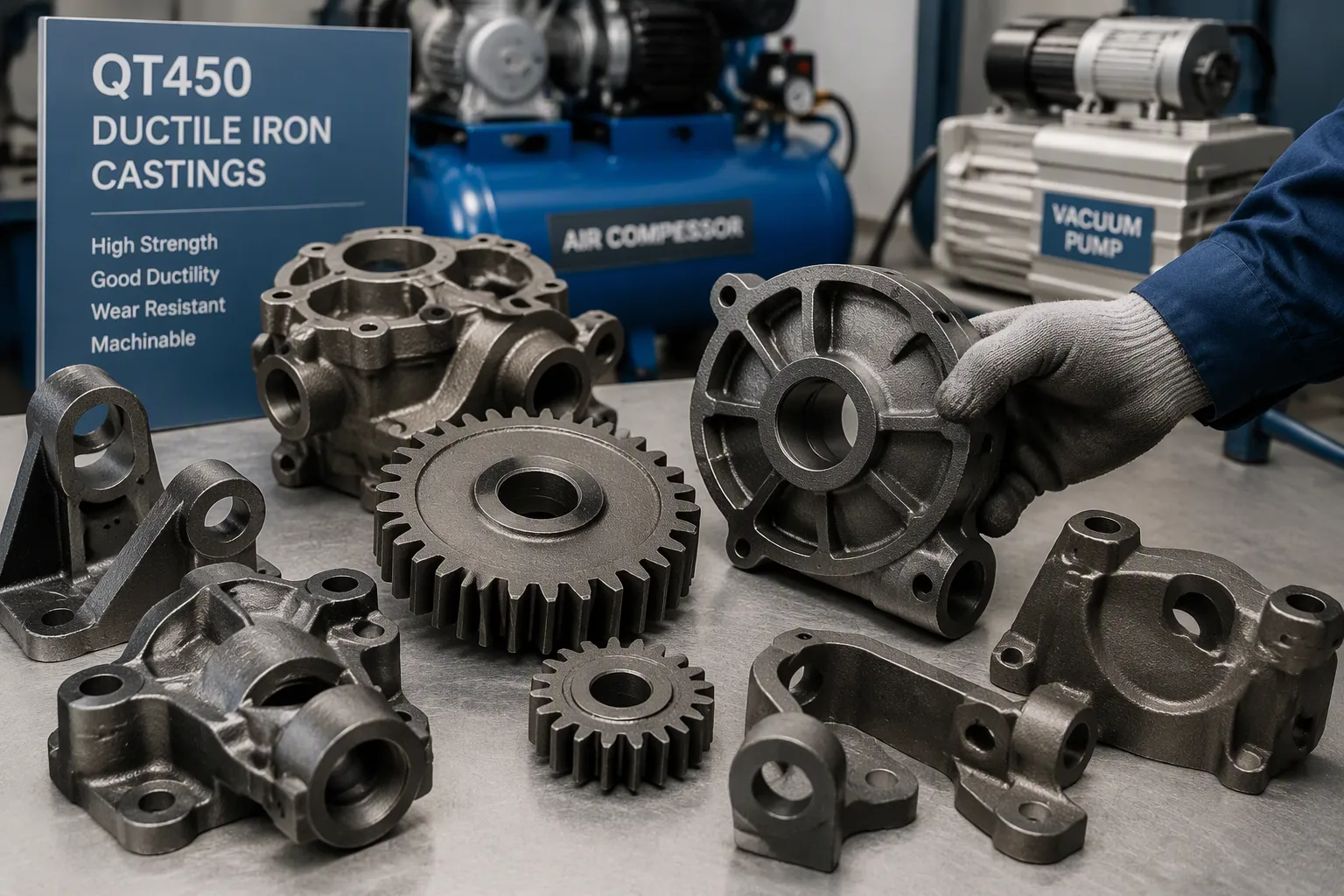
QT450 ductile iron is an excellent material choice for air compressor and vacuum machinery components. Its nodular graphite structure delivers high tensile strength and good elongation, with minimum values of ≥450 MPa and ≥10% respectively. The same microstructure effectively damps vibration, which helps protect equipment precision and reduce operating noise. QT450 also meets the pressure-tightness and dimensional stability demands of compressor housings, cylinder components, valve bodies, and vacuum pump parts. The material balances performance with machinability and cost-efficiency, making it suitable for both prototype and volume production. Controlled casting, rigorous quality inspection, and custom machining work together to ensure every part meets precise operational requirements.
| Property | Minimum Value |
|---|---|
| Tensile Strength σb (MPa) | ≥450 |
| Elongation δ (%) | ≥10 |
Key Takeaways
- QT450 ductile iron offers high strength and good vibration damping, making it ideal for compressor and vacuum parts.
- The production process includes strict quality checks to ensure reliable, pressure-tight castings.
- Custom machining turns castings into ready-to-install components with precise tolerances and finishes.
Material Performance
Mechanical Properties of QT450
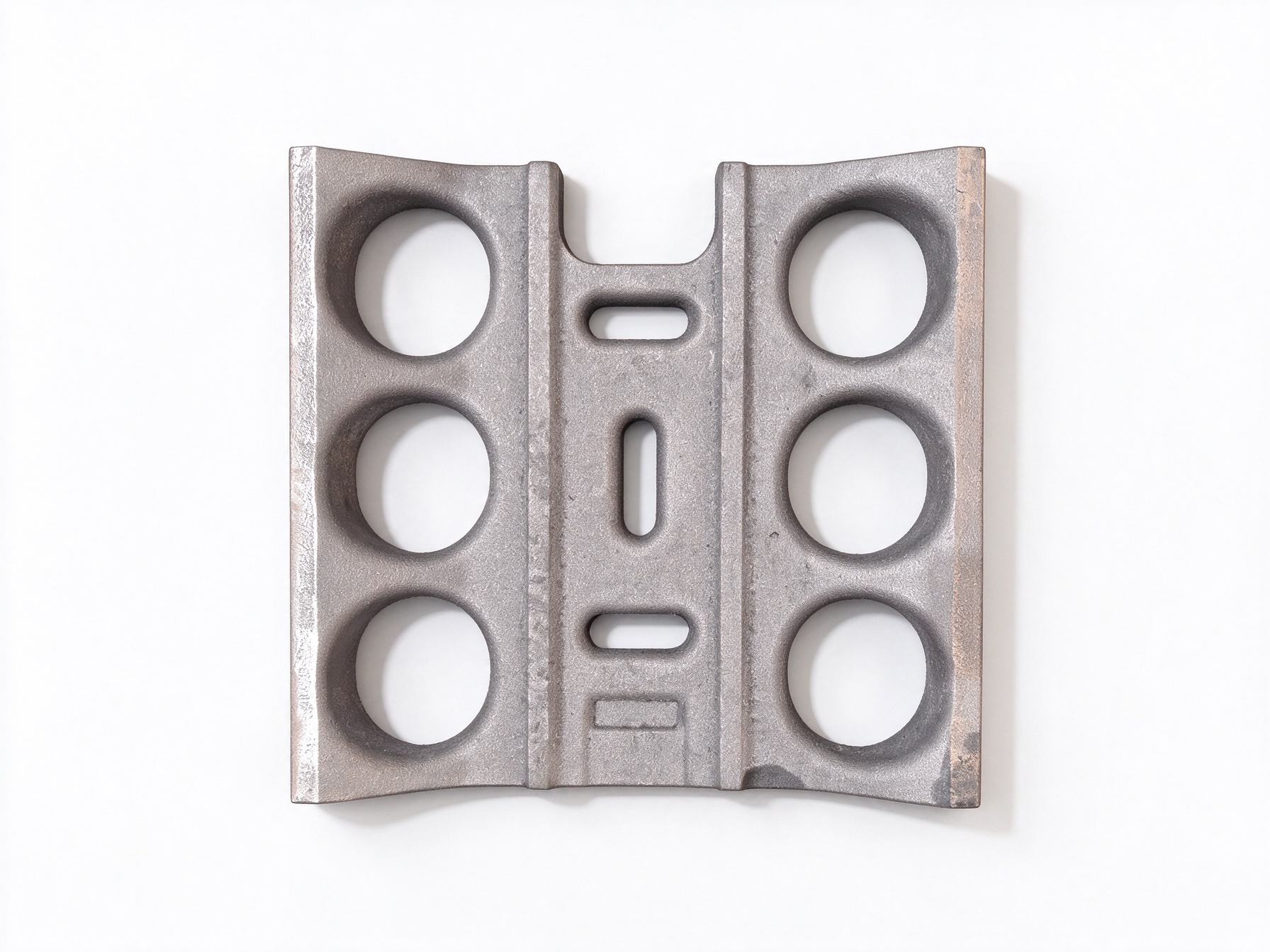
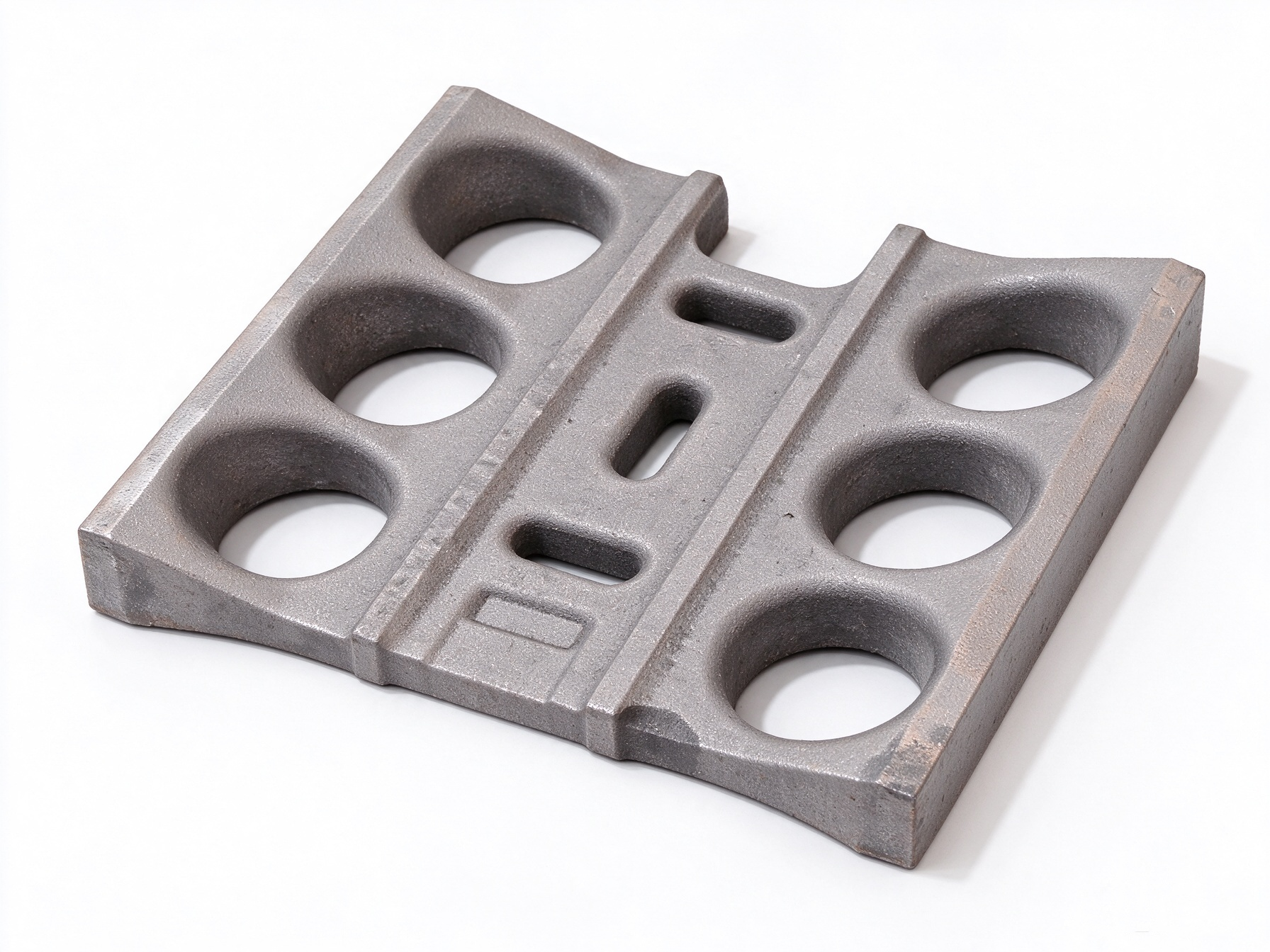
QT450 belongs to the ductile iron family, and its graphite takes the form of small nodules rather than flakes. This nodular structure interrupts crack paths and spreads stress more evenly through the metal matrix. The result is a material that combines respectable strength with useful ductility.
The grade designation itself states the core promise. QT450 delivers a minimum tensile strength of 450 MPa and a minimum elongation of 10%. These values hold across the specified wall thickness range when the foundry controls chemistry, nodularity, and cooling properly. A typical production heat will often exceed the minimums, which gives designers a modest safety margin.
| Property | Requirement | Typical Production Result |
|---|---|---|
| Tensile strength σb | ≥450 MPa | 480–550 MPa |
| Yield strength σ0.2 | ≥310 MPa | 320–360 MPa |
| Elongation δ | ≥10% | 12–18% |
| Hardness | 160–210 HB | 170–200 HB |
| Nodularity | ≥85% | 90% or higher |
Hardness in the 160–210 HB range keeps the material friendly to cutting tools. Compressor housings, cylinder blocks, and valve bodies all need bored holes, faced flanges, and tapped threads. QT450 machines cleanly at these hardness levels, and the chips break well. This combination of strength and machinability explains why the grade appears so often in pressure-containing machinery castings.
The matrix structure matters as much as the graphite. A ferritic matrix gives maximum ductility and impact toughness. A pearlitic matrix raises strength and wear resistance at some cost in elongation. Foundries adjust the matrix through alloying and heat treatment to match the duty cycle of the part. A vacuum pump housing that sees steady loads may favor a ferritic structure. A compressor component exposed to sliding wear may favor a partially pearlitic structure.
Fatigue Resistance for Cyclic Loading
Air compressors and vacuum pumps load their components in cycles. Pistons reciprocate, rotors spin, and pressure pulses travel through housings thousands of times per hour. Fatigue failure, not static overload, often governs the design life of these parts.
QT450 handles cyclic loading well for several reasons. The nodular graphite blunts stress concentrations at the microscopic level. The ferritic matrix absorbs strain without cracking. The casting skin, when left intact on non-machined surfaces, carries compressive residual stress that resists crack initiation.
Designers can further raise fatigue life through geometry. Generous fillets at section changes, gradual wall transitions, and rounded internal corners all reduce stress concentration factors. Shot blasting adds another layer of protection. Peening the surface induces compressive stress and closes small surface pores. A casting that receives shot blasting to Sa 2.5 grade typically shows measurably longer fatigue life than an as-cast surface.
Foundries also control fatigue performance through internal soundness. Shrinkage porosity and gas holes act as internal notches. A dense, sound casting with fine nodule count will outlast a porous one by a wide margin under the same cyclic load. This is why solidification control and defect inspection deserve serious attention in the production workflow.
Damping Capacity for Noise and Vibration
Ductile iron damps vibration far better than steel. The graphite nodules absorb vibrational energy as they deform against the surrounding matrix. This internal friction converts mechanical energy into heat instead of transmitting it through the structure.
For air compressor and vacuum machinery, damping translates directly into user benefits. Compressor housings made of QT450 radiate less airborne noise. Vacuum pump bodies hold alignment better because vibration decays quickly instead of building. Base plates and mounting frames made of the same material protect downstream precision equipment from transmitted vibration.
The damping advantage shows up clearly against welded steel fabrications. A welded steel base rings and transmits vibration unless designers add dampers or mass. A QT450 casting of similar stiffness quiets the same machine with no extra parts. The material also allows thin, ribbed sections that stiffen the structure without adding weight. Ribs cast into a housing raise natural frequency and push resonance away from the running speed of the machine.
Engineers should note that damping varies with matrix structure. Ferritic ductile iron damps slightly better than pearlitic ductile iron. A foundry can tune the heat treatment to favor whichever property the application values more.
Corrosion Resistance in Humid Environments
Compressor and vacuum equipment often runs in humid rooms, washdown areas, or outdoor installations. Moisture alone attacks unprotected iron slowly. Moisture plus chlorides attacks it much faster.
QT450 offers moderate corrosion resistance in plain humid air. A uniform surface scale forms and slows further attack. The material suits general industrial duty in these conditions. Where corrosion resistance becomes the governing requirement, stainless steel grades offer a better fit, and designers should weigh that option honestly during material selection.
Surface protection extends QT450’s service range considerably. Epoxy resin coatings applied to QT450 valve surfaces, at thicknesses of 200 μm or more, extend service life by roughly two to three years compared with uncoated cast iron in humid environments and chloride-containing media. The same approach appears in ductile iron pipeline valves for harsh high-temperature, humid, and corrosive service. Those valves use internal and external epoxy electrostatic spraying. The dense coating resists corrosion and scaling, and it extends service life in outdoor and buried applications.
For compressor and vacuum parts, a coating system typically combines shot blasting to Sa 2.5 grade with a primer and a topcoat. Black epoxy or powder electrostatic spray at 60–80 μm provides abrasion and chemical resistance for indoor equipment. Harsher duty calls for thicker systems. The coating decision should follow the actual environment, not a default specification.
Comparison with Alternative Materials
Material selection for compressor and vacuum machinery usually weighs QT450 against gray iron, carbon steel, and aluminum. Each option fits a different set of priorities.
| Material | Tensile Strength | Elongation | Damping | Corrosion (Uncoated) | Relative Cost | Best Fit |
|---|---|---|---|---|---|---|
| QT450 ductile iron | ≥450 MPa | ≥10% | Excellent | Moderate | Moderate | Pressure housings, valve bodies, bases needing strength plus damping |
| Gray iron (HT250) | ~250 MPa | <1% | Excellent | Moderate | Low | Rigid, low-stress housings and covers |
| Carbon steel (weldment) | 400+ MPa | High | Poor | Moderate | Moderate–High | Large frames, low-volume prototypes |
| Aluminum alloy | 150–300 MPa | Moderate–High | Moderate | Good (oxide layer) | Moderate–High | Weight-critical, low-pressure parts |
Gray iron costs less and damps well, but its flake graphite limits tensile strength and ductility. It fits covers, brackets, and lightly loaded housings. QT450 takes over when the part must hold pressure, carry load, or survive shock.
Carbon steel weldments offer high strength and design freedom for one-off frames. They damp poorly, need stress relief after welding, and require more machining steps to reach final geometry. QT450 casts complex shapes in one piece and machines to final dimensions with fewer operations.
Aluminum alloys win on weight. They lose on strength, damping, and cost at the same load rating. For stationary compressors and vacuum pumps, weight rarely governs, so QT450 usually delivers better value.
QT450 occupies a practical middle ground. It provides steel-like mechanical properties with the castability of iron. It damps vibration better than welded alternatives. It machines easily and accepts a range of coatings. For air compressor and vacuum machinery, these trade-offs line up well with real operating demands.
Production Workflow
Pattern Making and Mold Preparation
Production begins with process design. Engineers build a CAD model from the customer drawing and run CAE simulation of mold filling and solidification. They then optimize the gating system, riser, and chiller layout to minimize shrinkage cavities and air holes. The team crafts wooden or metal patterns for sand casting, steel molds for die casting, or solid foam models for lost foam casting. Molding sand uses quartz sand with a clay or resin binder, and the foundry controls strength and air permeability. Resin sand typically holds tensile strength of at least 1.2 MPa with moisture at or below 4%.
Ductile iron can be cast without a pattern: the sand mold and cores are printed directly from the CAD file, so no pattern is made, eliminating pattern amortization and making single castings economic.
Melting and Nodularization Treatment
Melting runs in a 3-ton medium-frequency induction furnace. The charge combines 50% Q10 pig iron with 50% low-manganese shredded steel scrap. Magnesium treatment is the defining step. Operators add magnesium at 0.4–0.7% in the ladle to neutralize sulfur and convert flake graphite into spheroids. A residual magnesium of 0.02–0.06% in the final casting confirms successful nodularization. The foundry targets a composition of C 3.6–3.7%, Si 2.3–2.4%, Mn ≤0.2%, P ≤0.03%, and S ≤0.012%. A 75% Si-Ba ferrosilicon inoculant at 0.15% during pouring refines the graphite further.
Pouring and Solidification Control
Pouring temperature for ductile iron runs 1350–1420°C, and the flow rate stays at 0.5–1.0 kg/s to avoid turbulence, slag inclusions, and porosity. Bottom pouring reduces oxidation slag. Thick walls call for slow pouring, thin walls for fast pouring to prevent cold shuts. The melt should solidify in the near-eutectic mode, which yields high nodularity, small uniformly distributed nodules, and low shrinkage tendency.
| Parameter | Value |
|---|---|
| Filling temperature | 1350–1400°C |
| Maximum pressure | 0.15 MPa |
| Solidification time | 180 s |
| Shrinkage risk | None |
Heat Treatment and Stress Relief
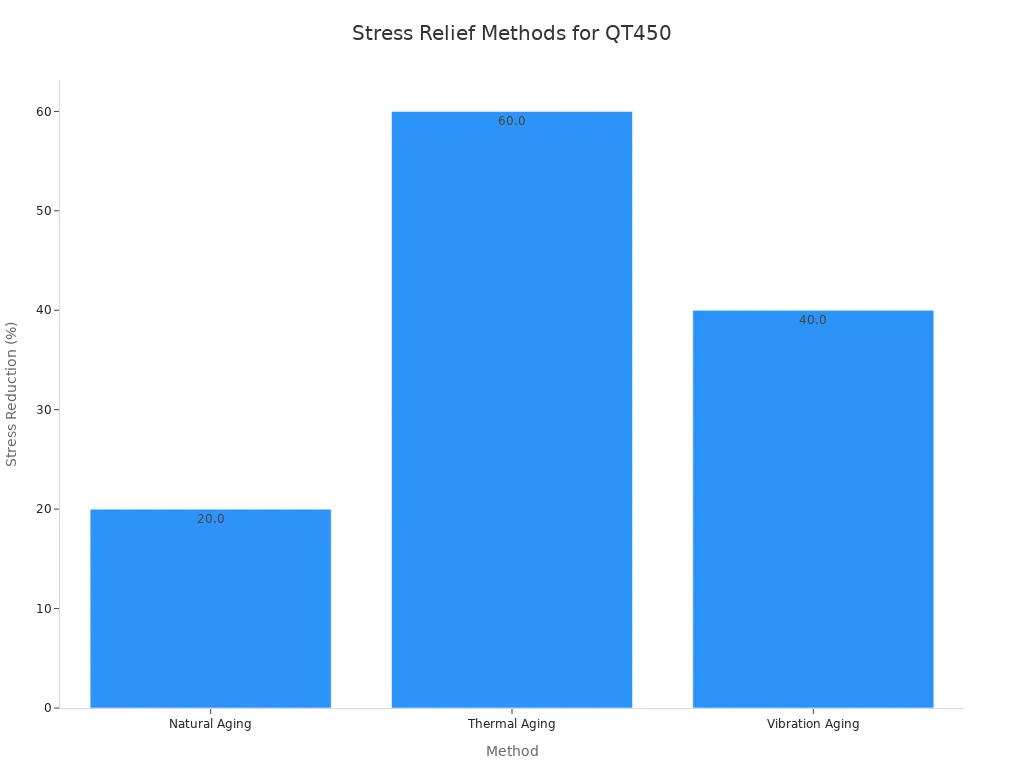
Stress relief annealing heats castings to 500–550°C, holds for 2–8 hours, then cools them. This step removes 90–95% of internal stress without altering the structure. Operators avoid exceeding 550°C or long holds, which can cause graphitization that lowers strength and hardness. Castings also cool slowly in the mold at roughly 25°C/h for parts under 3 tons. Unloading temperature stays below 300°C.
Finishing and Dimensional Verification
Finishing starts with vibrating shakeout to remove molding sand, followed by riser removal by gas cutting or sawing. Shot blasting cleans the surface to Sa 2.5 grade, and grinding removes flash and burrs. Dimensional verification combines CMM inspection with Faro portable measurement arms, vernier calipers, micrometers, dial indicators, and thread gauges. A full dimensional report covers sample, first-article, and production-batch checks of critical and general dimensions.
Quality Control
Incoming Material and Melt Inspection
Quality control starts before the furnace lights. The foundry checks incoming pig iron and scrap for chemistry and cleanliness. Operators take a spectral analysis sample from each furnace batch to confirm carbon, silicon, manganese, sulfur, phosphorus, magnesium, and rare earth content. This step catches composition drift early, before it reaches the mold.
Casting Defect Detection Methods
Inspectors combine several methods to find surface and internal defects:
- Visual inspection checks for cracks, sand inclusion, sand holes, air holes, cold flakes, mismatch, and machining scratches. Air holes show smooth regular interiors, while sand holes appear irregular with residue.
- Magnetic particle inspection suits ductile iron and works well with fluorescent magnetic particle testing. Grinding the surface improves sensitivity.
- Ultrasonic testing detects air holes, sand holes, slag inclusion, and cracks. Ductile iron’s complex internal structure makes interpretation harder, so skilled operators matter.
- X-ray inspection reveals internal porosity and shrinkage that other methods may miss.
Mechanical and Metallographic Testing
Each production lot undergoes tensile testing to GB/T 228.1 and Brinell hardness testing to GB/T 231.1. Metallographic examination grades graphite spheroidization and the ferrite matrix ratio.
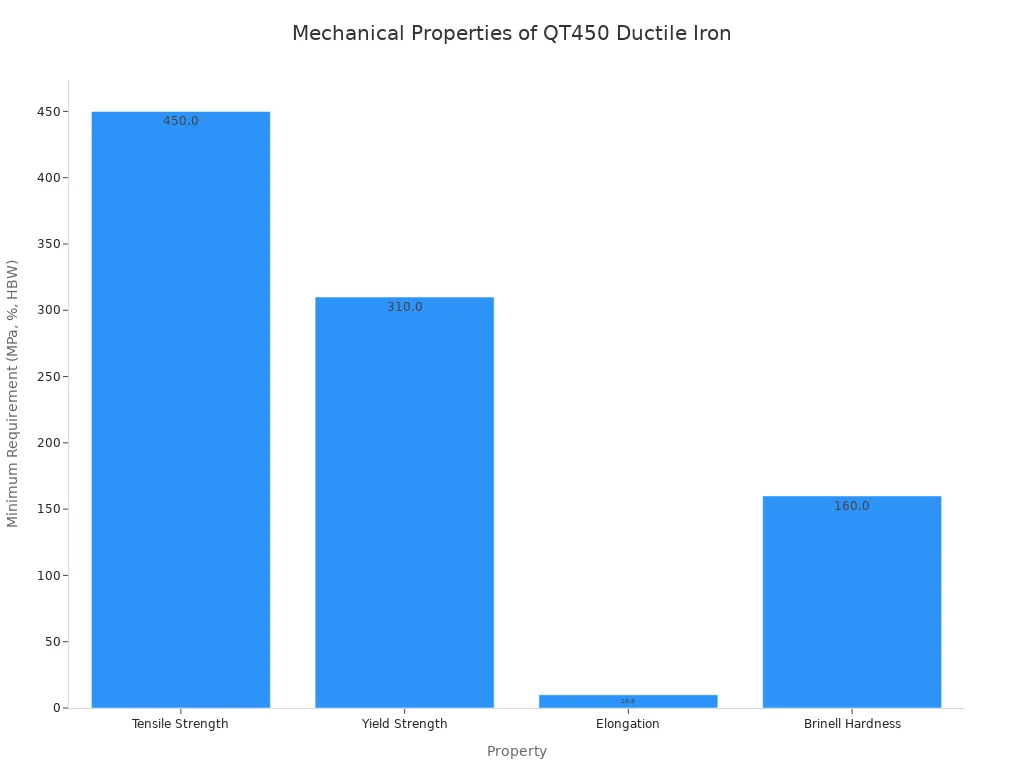
| Property | Symbol | Minimum Requirement |
|---|---|---|
| Tensile Strength | Rm | ≥450 MPa |
| Yield Strength | Rp0.2 | ≥310 MPa |
| Elongation After Fracture | A | ≥10% |
| Brinell Hardness | HBW | 160–210 |
Standards and Certifications
Production follows GB/T 1348-2019 for ductile iron castings and GB/T 9441-2009 for metallographic inspection. The foundry also supports DIN and GOST standards for global customers. Full material reports and dimensional inspection reports accompany each delivery.
Custom Machining Services for QT450 Ductile Iron Casting Parts
Machining Capabilities and Equipment
Casting alone rarely delivers a ready-to-install part. QT450 blanks need bored holes, faced flanges, drilled ports, and tapped threads before they enter an assembly line. The machine shop handles these operations on CNC machining centers, lathes, and boring mills. A documented project on QT450 ductile iron knuckles for agricultural tillage machinery shows the standard pattern: sand casting followed by CNC machining. The same approach applies to compressor housings and vacuum pump bodies. CNC operations turn sand-cast blanks into finished components with repeatable geometry.
Achievable Tolerances and Surface Finishes
Machining holds tolerances that casting cannot reach on its own. Critical bores and mating faces typically achieve ±0.02 mm to ±0.05 mm, while general dimensions follow GB/T 6414 CT8–CT10 casting grades before machining refines them. Surface roughness on machined faces generally falls in the Ra 1.6–3.2 μm range. Bearing seats and sealing surfaces receive finer finishes where the drawing demands them.
Additional Finishing and Treatment Options
Finishing protects the machined part and prepares it for service. Available options include:
- Shot blasting
- Anti-rust oil
- Powder coating
- Painting
Shot blasting cleans the surface to Sa 2.5 grade before coating. Anti-rust oil protects parts during shipping and storage. Powder coating and painting add durable barriers against moisture and chemicals.
Prototyping Through Volume Production Support
The same workflow serves a single prototype and a full production run. Engineers review drawings, build the pattern or foam model, cast the blank, machine it, and apply finishes. First-article inspection confirms dimensions before volume release. Batch production then repeats the process under the same quality controls, so early samples and later deliveries match.
QT450 ductile iron casting parts combine proven strength, fatigue resistance, damping, and corrosion performance for air compressor and vacuum machinery. A disciplined production workflow and multi-stage quality control protect consistency and pressure-tightness. Custom machining turns castings into ready-to-install components with precise tolerances and finishes.
US industrial buyers can send 2D/3D drawings, technical standards, and special inspection requirements for a free DFM manufacturability review and a formal quotation. The foundry supplies QT450 ductile iron castings with in-house CNC secondary machining. Prototype, small batch, and large volume production are all available.
FAQ
Does QT450 suit high-pressure compressor housings?
Yes. QT450 delivers at least 450 MPa tensile strength and 10% elongation. Sound castings hold pressure reliably. The foundry verifies tightness through inspection and testing before shipment.
Can the foundry supply finished machined parts instead of raw castings?
Yes. The foundry offers one-stop delivery. Buyers receive raw castings, semi-finished parts, or fully machined components with bored holes, drilled ports, and tapped threads. Each order includes material and dimensional reports.
Which standards govern QT450 castings?
Production follows GB/T 1348-2019 for ductile iron castings and GB/T 9441-2009 for metallographic inspection. The foundry also supports DIN and GOST specifications for global buyers.
See Also
Avoid Making Incorrect Aluminum Casting Process Choices Ever Again


Reviews
There are no reviews yet.